

Scattered disc
Images

The FERMI gamma-ray sky map - in COLOR

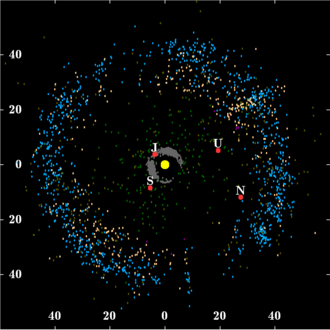


Defining the Scattered Disc
The Scattered disc (or scattered disk) represents a distinct and dynamically active region within our solar system, situated beyond the orbit of Neptune. It is characterized by a sparse population of icy small Solar System bodies, a subset of the broader Trans-Neptunian Objects (TNOs). What sets these Scattered Disc Objects (SDOs) apart are their extreme orbital parameters.
They exhibit high orbital eccentricities, reaching up to 0.8, meaning their paths are highly elliptical rather than nearly circular. Furthermore, their inclinations can be as high as 40 degrees, tilting them significantly above or below the ecliptic plane, the relatively flat plane on which most planets orbit. Their perihelia, the point in their orbit closest to the Sun, are greater than 30 astronomical units (AU), placing them firmly in the outer solar system.
This contrasts with the more tightly packed and less inclined orbits found within the main Kuiper Belt, though the inner boundaries of the Scattered disc do overlap with it. The sheer distance and the extreme nature of their orbits make SDOs some of the coldest and most remote objects known in our solar system.
The Gravitational Sculpting
The peculiar and often chaotic orbits of objects within the Scattered disc are not a natural occurrence but rather the result of powerful gravitational interactions. The primary sculptor of the Scattered disc is believed to be the giant planet Neptune. As Neptune migrated outwards during the early history of the solar system, its immense gravitational influence 'scattered' smaller icy bodies from more stable regions, such as the Kuiper Belt, onto highly eccentric and inclined trajectories.
These objects are not static; they continue to be subject to perturbations from Neptune, which prevents their orbits from stabilizing into a more compact configuration. This ongoing interaction means the Scattered disc is a dynamically evolving environment. Some astronomers also consider that objects with even more extreme orbits, known as detached objects, might represent a further stage of scattering or originate from even more distant reservoirs, blurring the lines between these distinct populations.
A Cosmic Factory
The Scattered disc plays a crucial role in our understanding of cometary dynamics. Due to its inherently unstable nature, it is considered the primary source region for the majority of periodic comets that grace our inner solar system. The gravitational nudges from Neptune and other giant planets can further perturb SDOs, sending them on trajectories that eventually lead them towards the Sun.
As these icy bodies migrate inwards, they often pass through an intermediate stage known as 'centaurs.' Centaurs are a population of icy bodies found between Jupiter and Neptune, exhibiting characteristics of both asteroids and comets. Eventually, these centaurs can be further influenced by the inner giant planets, transforming them into periodic comets with well-defined, recurring orbits that bring them back to the Sun at regular intervals. Therefore, studying the Scattered disc provides invaluable insights into the origins and evolution of these fascinating celestial visitors.
Interconnections and Implications for Solar System Formation
The Scattered disc is not an isolated phenomenon but is intricately linked to other regions and populations within the solar system. Its outer limits extend far beyond the main Kuiper Belt, reaching distances that approach the theoretical inner edge of the Oort Cloud, another vast reservoir of icy bodies. Indeed, many objects proposed to reside in the Oort Cloud are also thought to have originated in the Scattered disc, having been ejected even further out by gravitational interactions.
The distinction between Scattered disc objects and detached objects can also be blurry, with some objects, like Sedna, sometimes being classified within the Scattered disc due to their extreme orbits. Understanding the composition, distribution, and orbital dynamics of SDOs provides critical data for refining models of solar system formation and evolution, helping scientists piece together the complex history of our cosmic neighborhood and the processes that shaped it.
Go deeper
Frequently Asked Questions
What is the Scattered disc?+
Why do objects in the Scattered disc have such wiggly orbits?+
How far from the Sun are Scattered disc objects?+
What happens to Scattered disc objects that come closer to the Sun?+
Are Scattered disc objects the same as Kuiper Belt objects?+
Based on content from Wikipedia · Licensed under CC BY-SA 4.0