

San Siro: The Giant Football Castle!
Images

Stadio Giuseppe Meazza, San Siro, Milan


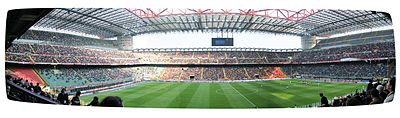
The Architectural Grandeur and Dual Tenancy of San Siro
San Siro, officially known as the Stadio Giuseppe Meazza, stands as a colossal testament to sporting architecture in Milan, Italy. With a staggering seating capacity of 75,817, it proudly holds the title of the largest stadium in Italy and ranks among the most capacious in Europe. This immense structure is uniquely the shared home of two of Italy's most storied football clubs, AC Milan and Inter Milan.
This dual tenancy creates a dynamic and often intense rivalry, most famously embodied in the 'Derby della Madonnina,' a fixture that electrifies the city and draws global attention. The stadium's design, characterized by its imposing concrete structure and distinctive cylindrical towers, has evolved significantly since its inauguration in 1926, undergoing numerous renovations to maintain its status as a premier sporting venue. Its sheer scale and historical significance make it a pilgrimage site for football aficionados worldwide, a place where the echoes of legendary matches resonate through its vast stands.
A Legacy Forged in Football History
The stadium's renaming in 1980 to honor Giuseppe Meazza marked a pivotal moment, embedding the legacy of one of Italy's greatest footballers into its very fabric. Meazza, a two-time World Cup winner in 1934 and 1938, was a pivotal figure for Inter Milan during the stadium's formative decades. This dedication underscores San Siro's deep connection to the golden era of Italian football.
Beyond its club affiliations, San Siro has been a hallowed ground for international football tournaments. It hosted crucial matches during the 1934 FIFA World Cup and was a central venue for the 1990 FIFA World Cup, including the opening ceremony. Its role in the UEFA Euro 1980 further solidifies its international pedigree.
The stadium has also been the stage for four prestigious European Cup finals, underscoring its capacity to host the highest caliber of club competition, solidifying its place in football's annals.
San Siro's Multifaceted Significance and Future
San Siro's importance transcends its role as a football arena; it is a UEFA Category Four stadium, signifying its adherence to the most stringent international standards for infrastructure and safety. This designation is crucial for its ability to host major continental and global events. Its historical significance is further amplified by its selection as a key venue for the 2026 Winter Olympics, where it will host the opening ceremony.
This demonstrates its enduring relevance and adaptability as a world-class entertainment and sporting complex. The stadium's capacity for hosting large-scale concerts and other cultural events also highlights its versatility, making it a vital cultural nexus for Milan and a significant contributor to the city's global profile. San Siro is not merely a building; it is a living monument to sporting achievement and cultural celebration.
Architectural Evolution and Enduring Appeal
The architectural journey of San Siro is a fascinating study in stadium development. Originally conceived as a more intimate venue, its continuous expansion and modernization have transformed it into the colossal structure it is today. The iconic tiered seating and the distinctive external cylindrical towers, added during renovations, have become synonymous with its identity.
These design elements not only enhance spectator experience but also contribute to its imposing visual presence. The stadium's ability to adapt to evolving technological and safety standards, while retaining its historical character, is a testament to thoughtful urban planning and architectural foresight. As Milan prepares to host the 2026 Winter Olympics, San Siro's role in the opening ceremony signifies its continued evolution and its unwavering position as a landmark of international importance, poised to create new memories for future generations.
See also
Frequently Asked Questions
What is San Siro?+
Why is it called Stadio Giuseppe Meazza?+
What big football events have happened there?+
How big is San Siro compared to other stadiums?+
Can people do other things at San Siro besides football?+
Based on content from Wikipedia · Licensed under CC BY-SA 4.0