

Saint Pierre and Miquelon
Images

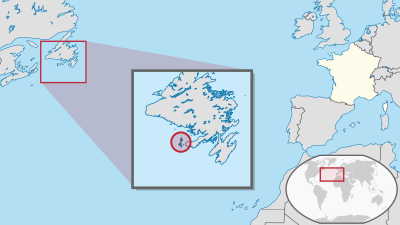
Saint Pierre and Miquelon on the globe (North America centered)




![Un soumissionnaire au marché, Saint Pierre et Miquelon / [A bidder at the market], Saint-Pierre and Miquelon](https://live.staticflickr.com/7267/8157827255_7fccaa0bcc_n.jpg)


Opens Google Maps in new tab
Geopolitical Anomaly
Saint Pierre and Miquelon presents a fascinating geopolitical case study as a self-governing territorial collectivity of France situated in the northwestern Atlantic Ocean, mere kilometers from the Canadian province of Newfoundland and Labrador. This archipelago, comprising eight islands with a total land area of 242 km², is an Overseas Country and Territory (OCT) of the European Union, though not an integral part of it, nor part of the Schengen area or the European customs territory.
Despite its geographical isolation from Metropolitan France-separated by 3,819 kilometers to Brest-its residents are French citizens, participating in national elections and holding a deputy in the National Assembly. This unique status grants them EU citizenship and the use of the Euro, while also necessitating distinct arrangements for trade and immigration. The islands' location near the entrance to the Gulf of St.
Lawrence places them in proximity to vital shipping lanes and historically significant fishing grounds, influencing their strategic importance and economic development over centuries.
Echoes of the Past
The historical narrative of Saint Pierre and Miquelon is inextricably linked to the lucrative cod fisheries of the Grand Banks. Claimed by France in the 16th century, the islands’ sovereignty was a recurring point of contention between France and Great Britain, leading to periods of French, British, and even Dutch control. They served as a crucial base for French fishermen, a hub for trade, and at times, a strategic military outpost.
The islands experienced periods of intense prosperity, particularly during the 18th and 19th centuries when fishing was paramount. However, they also faced significant challenges, including devastating fires, economic downturns, and shifts in fishing quotas. Despite these upheavals, the inhabitants, often descended from Basque, Breton, and Norman fishermen, have consistently maintained a strong French cultural identity and a deep connection to the maritime environment, demonstrating remarkable resilience through centuries of fluctuating political and economic fortunes.
Cultural Fabric
The cultural landscape of Saint Pierre and Miquelon is a distinctive fusion of French heritage and the realities of island life. The official language is French, and the societal norms, cuisine, and administrative systems are distinctly French. Residents, numbering around 5,819, enjoy a high quality of life, characterized by strong community bonds and a deep appreciation for their unique environment.
The islands’ isolation has fostered a close-knit society where traditions are well-preserved. While embracing their French citizenship and European connections, the people of Saint Pierre and Miquelon also navigate their distinct North American context. This duality is reflected in their daily lives, from the architecture that blends European styles with practical island adaptations to the local dialect and customs that have evolved over generations, creating a culture that is both authentically French and uniquely Saint-Pierrais.
Economic Evolution
Historically, the economy of Saint Pierre and Miquelon was almost entirely dependent on fishing, particularly cod. The decline of cod stocks due to overfishing and environmental changes necessitated a significant economic pivot. While fishing, focusing on species like crab and shrimp, remains a vital sector, it is no longer the sole pillar.
The territory has actively pursued economic diversification. Tourism has emerged as a growing industry, attracting visitors drawn to its unique French culture, dramatic landscapes, and maritime history. Other sectors include administrative services, public sector employment, and a nascent aquaculture industry. The islands also benefit from their status as an OCT, receiving structural funds from the EU and maintaining trade relations with Canada and France.
This strategic diversification aims to ensure the long-term economic viability and stability of the archipelago.
Governance and Autonomy
Saint Pierre and Miquelon operates as a territorial collectivity, a status that grants it a significant degree of autonomy within the French Republic. It possesses its own elected assembly and president, responsible for managing local affairs, including education, health, and infrastructure. French law applies, but the local government has the power to adapt or implement specific regulations suited to the islands' context.
Residents are French citizens and participate in all French national elections, electing one deputy to the National Assembly and three senators. This representative democracy ensures that the islands' interests are voiced at the national level. As an OCT of the EU, it benefits from certain EU programs and trade advantages while maintaining its distinct legal and customs status.
This complex governance structure allows Saint Pierre and Miquelon to balance its French identity with the practicalities of self-management in a remote location.
See also
Based on content from Wikipedia · Licensed under CC BY-SA 4.0