

Sagittarius A*
Images
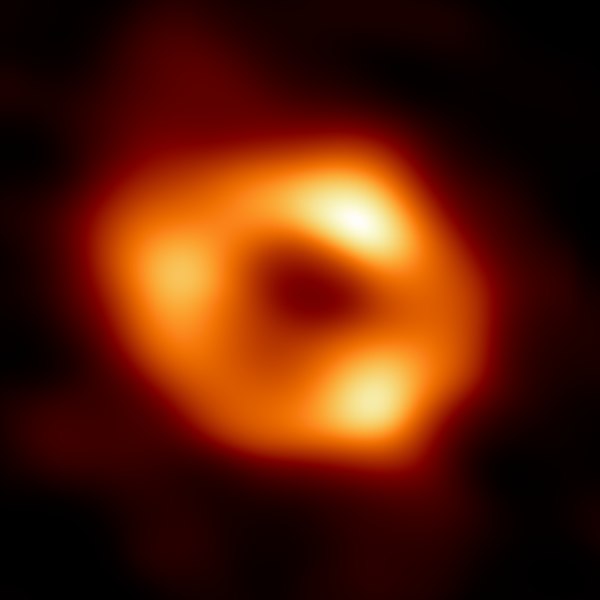
Sagittarius A*
The Gravitational Anchor of the Milky Way
Sagittarius A* (Sgr A*) resides at the dynamical center of the Milky Way galaxy, a region characterized by intense gravitational forces and a high density of stars. Its existence was inferred for decades through the precise tracking of stellar orbits, most notably the star S2, which completes an orbit around Sgr A* in a mere 16 years. These observations allowed astronomers to calculate the mass and constrain the radius of the central object, leading to the inescapable conclusion that it must be a supermassive black hole.
The current best estimate places its mass at approximately 4.297 million solar masses. This immense gravitational pull acts as the anchor for the galaxy, influencing the motion of stars and gas clouds within the central parsecs and playing a critical role in galactic evolution and structure. Understanding Sgr A* is therefore fundamental to comprehending the overall dynamics and history of our home galaxy.
From Radio Source to Shadowy Silhouette
The identification of Sgr A* began with its detection as a bright, compact astronomical radio source in 1974 by Bruce Balick and Robert L. Brown. Brown further refined this discovery in 1982, assigning the asterisk (*) to denote the most compact and intense radio emission originating from a non-thermal source embedded within the larger Sagittarius A complex. The quest to visualize this enigmatic object culminated in the groundbreaking release of its first image in May 2022 by the Event Horizon Telescope (EHT) collaboration.
This international network of radio observatories, using very long baseline interferometry, effectively created a planet-sized telescope capable of resolving the fine details around Sgr A*'s event horizon. The resulting image is not of the black hole itself, which is inherently invisible, but of the silhouette it casts against the luminous, superheated plasma of its accretion disk.
Probing the Limits of Physics and Galactic Evolution
The study of Sagittarius A* holds profound implications for astrophysics and fundamental physics. Its immense mass and proximity allow astronomers to test the predictions of Einstein's theory of general relativity in extreme gravitational environments. The precise measurements of stellar orbits around Sgr A* have provided strong evidence for its nature as a supermassive black hole, a conclusion that earned Reinhard Genzel and Andrea Ghez a share of the 2020 Nobel Prize in Physics.
Sir Roger Penrose also received a Nobel Prize for his theoretical work demonstrating that black hole formation is a robust prediction of general relativity. Beyond testing fundamental physics, Sgr A* is a key object for understanding the co-evolution of supermassive black holes and their host galaxies, shedding light on processes like active galactic nuclei and the feedback mechanisms that regulate star formation.
The Energetics of the Galactic Core
The visual representation of Sgr A* by the EHT reveals the dynamic environment surrounding the black hole. The bright ring observed is not the black hole's surface but rather the emission from gas and dust heated to millions of degrees as it spirals inward towards the event horizon. This process, known as accretion, generates intense radiation across the electromagnetic spectrum, particularly in radio and infrared wavelengths, which are observable from Earth.
The structure and dynamics of this accretion disk provide crucial data for understanding accretion physics, magnetic field configurations, and the mechanisms that launch relativistic jets, although Sgr A* appears to be relatively quiescent compared to some other active galactic nuclei. Studying this energetic phenomenon helps us comprehend the energy output of galactic centers and their impact on the surrounding interstellar medium.
See also
Frequently Asked Questions
What is Sagittarius A*?+
Why is Sagittarius A* called a black hole?+
How do scientists know Sagittarius A* is at the center of the Milky Way?+
When did we first see a picture of Sagittarius A*'s shadow?+
How big is Sagittarius A* compared to the Sun?+
Based on content from Wikipedia · Licensed under CC BY-SA 4.0