

The Rufous Hornero: South America's Mud-Pie Builder!
Images
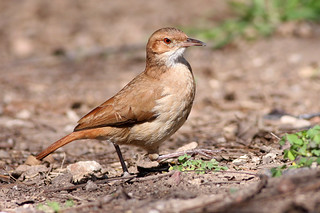
Rufous Hornero (Furnarius rufus)


Ecological Distribution and Habitat Preferences
The Rufous Hornero (Furnarius rufus) occupies a significant ecological niche across eastern South America, with its range extending from midwestern and southeastern Brazil through Bolivia, Paraguay, Uruguay, and down to northern and central Argentina, even reaching northern Patagonia. Its preferred habitats are open and semi-open environments, including savannas, grasslands, second-growth scrub, pastures, and agricultural lands.
This adaptability to disturbed and human-modified landscapes is a key factor in its widespread distribution and abundance. The species is classified as synanthropic, indicating a strong tendency to live in close proximity to human settlements and activities, often nesting on or near human structures and utilizing agricultural areas for foraging. This close association has likely contributed to its conservation status of Least Concern, as its habitat is often maintained or even expanded by human land use.
Morphological Adaptations and Foraging Behavior
Morphologically, the Rufous Hornero is characterized by its medium size, a square tail, and a slightly decurved bill, adaptations suited for its ground-based foraging. Its plumage is predominantly reddish-brown, with a duller brown crown and a contrasting whitish throat. While sexes are outwardly similar, juveniles may appear slightly paler ventrally, possibly due to less accumulated dirt.
The primary foraging strategy involves walking on the ground, actively searching for insects and other arthropods. This method requires keen observation and quick reflexes to capture prey. The species is also known to be an opportunistic feeder, readily consuming scraps like bread crumbs when available, further demonstrating its adaptability to human-influenced environments.
This dietary flexibility is crucial for survival in varied ecological conditions.
The Iconic Mud-Oven Nest
The most defining characteristic of the Rufous Hornero is its distinctive nest, which gives the bird its name ('hornero' meaning 'baker' in Spanish). These nests are not woven from twigs but are constructed from mud mixed with organic materials like grass and straw. The birds meticulously gather mud, often from riverbanks or damp soil, and transport it to the nest site, typically on a tree branch, fence post, or even a building.
They then shape the mud with their beaks and feet, creating a thick-walled, dome-shaped structure that resembles a small oven. This robust construction provides excellent thermal insulation, protecting eggs and nestlings from temperature fluctuations and predators. The nests are often reused and added to over successive breeding seasons, becoming substantial structures that can persist long after the birds have departed.
Vocalizations, Social Behavior, and Conservation
Rufous Horneros exhibit interesting social and vocal behaviors. They are known to sing duets, with distinct vocalizations between males and females. The rapid trill, a common component of their duet, is faster in males than in females.
A fascinating aspect of their singing is the accompanying wing-beating; both sexes beat their wings at their sides at a rate synchronized with their trill. Observing the speed of wing beats during singing can, therefore, allow for sex identification. While not extensively studied in terms of complex social structures, their widespread presence and adaptability suggest a successful evolutionary strategy.
As mentioned, the Rufous Hornero is classified as Least Concern by the IUCN, reflecting its stable population and extensive range, a testament to its ecological resilience and successful integration into diverse South American landscapes.
See also
Frequently Asked Questions
What does a Rufous Hornero look like?+
Why does a Rufous Hornero build a mud oven?+
Where can you find a Rufous Hornero?+
How does a Rufous Hornero find food?+
How can you tell if a Rufous Hornero is male or female?+
Based on content from Wikipedia · Licensed under CC BY-SA 4.0