

Rosalind (moon)
Images

Rosalind (moon)


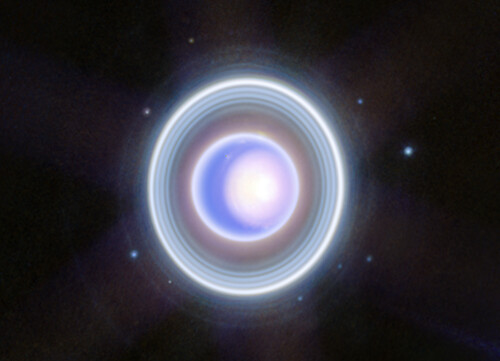


Rosalind
Rosalind is classified as one of Uranus's inner moons, a group that includes Cordelia, Ophelia, Bianca, Cressida, Desdemona, Juliet, Portia, and Cupid. These moons orbit Uranus at relatively close distances and are generally smaller and less massive than the five larger, classical moons (Miranda, Ariel, Umbriel, Titania, and Oberon). Rosalind's diameter is estimated to be around 72 kilometers (45 miles), and its irregular, non-spherical shape is characteristic of many smaller celestial bodies.
Its surface is notably dark, suggesting a composition rich in carbonaceous materials or tholins, which absorb a significant amount of incident sunlight. The close proximity to Uranus subjects Rosalind to strong tidal forces, which likely contribute to its irregular shape and prevent it from evolving into a more spherical form. Understanding the dynamics and composition of these inner moons is crucial for comprehending the formation and evolution of the entire Uranian system.
A Swift Orbital Period and Its Implications
Rosalind distinguishes itself with an exceptionally short orbital period of approximately 0.51 Earth days, or about 12.2 hours. This rapid revolution around Uranus places it among the fastest-orbiting moons in our solar system. For context, the Moon orbits Earth in about 27.3 days, and even Jupiter's innermost moon, Metis, takes about 0.3 Earth days.
Rosalind's orbital radius is roughly 69,700 kilometers (43,300 miles) from the center of Uranus. This close orbit means that Uranus would appear enormous in Rosalind's sky, dominating the view and exerting powerful gravitational influence. The speed and proximity of Rosalind suggest it may be part of a complex system of interacting moons and rings, potentially influencing or being influenced by the dynamics of Uranus's faint ring system.
Compositional Clues and Surface Characteristics
The composition of Rosalind is inferred to be primarily a mixture of water ice and rocky materials. Its dark albedo (reflectivity) is a key characteristic, indicating the presence of non-icy, dark surface materials. These could include organic compounds, graphite, or other dark minerals.
Unlike the larger Uranian moons, which show evidence of past geological activity like cryovolcanism or tectonic shifts, Rosalind is believed to be geologically inert. Its surface is likely ancient and heavily cratered, bearing the marks of countless impacts from comets and asteroids throughout its history. Studying the surface features and composition of Rosalind and its fellow inner moons can provide valuable insights into the primordial materials available during the formation of the outer solar system and the conditions within the early Uranian nebula.
Discovery and the Literary Naming Tradition
Rosalind was first observed and documented in 1851 by the English astronomer William Lassell. Lassell was a prolific observer who made significant contributions to lunar and planetary astronomy, including the discovery of Neptune's moon Triton in 1846. The naming of Uranus's moons follows a specific tradition, established by John Herschel, son of astronomer William Herschel (who discovered Uranus).
All moons of Uranus are named after characters from the literary works of William Shakespeare and Alexander Pope. Rosalind is named after the witty and resourceful protagonist of Shakespeare's pastoral comedy 'As You Like It.' This unique naming convention connects the scientific exploration of the cosmos with the rich tapestry of human literature and culture, offering a distinct identity to each celestial body within the Uranian system.
Rosalind's Place in the Uranian System and Beyond
Rosalind's existence and characteristics are integral to understanding the complex architecture of the Uranian system. As an inner moon, it likely formed from the same protoplanetary disk that coalesced around Uranus or was captured early in its history. Its rapid orbit and close proximity suggest it may play a role in shaping or maintaining the inner edge of Uranus's ring system, although the exact nature of this interaction is still a subject of research.
The dark, cratered surface of Rosalind serves as a record of the bombardment history in the outer solar system. Comparative planetology, studying moons like Rosalind alongside other small bodies in the solar system, helps scientists refine models of planetary formation and evolution. The literary name also serves as a reminder of humanity's enduring quest to understand our place in the universe, linking scientific discovery with cultural heritage.
See also
Frequently Asked Questions
What is Rosalind and where does it orbit?+
Why is Rosalind's surface dark?+
How fast does Rosalind orbit Uranus?+
Who discovered Rosalind and when?+
Why is Rosalind named after a Shakespeare character?+
Based on content from Wikipedia · Licensed under CC BY-SA 4.0