

Roman Theatre (Mérida)
Images

Teatro romano de Mérida. España-3


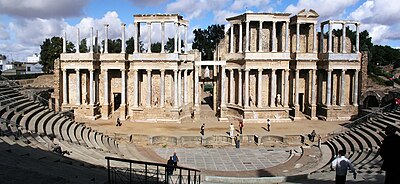


Architectural Grandeur and Roman Spectacle
The Roman Theatre of Mérida, originally known as Emerita Augusta, stands as a monumental testament to Roman urban planning and cultural priorities. Commissioned by consul Vipsanius Agrippa and inaugurated between 16 and 15 BCE, its construction signifies the importance of public entertainment in Roman colonial life. The theatre's design exemplifies classical Roman architectural principles, featuring a vast, semi-circular 'cavea' capable of seating thousands, meticulously engineered for optimal acoustics and sightlines.
The 'scaena,' or stage area, was the focal point for dramatic performances, complemented by the imposing 'scaenae frons' – the elaborately decorated rear wall that served as both a scenic backdrop and an architectural statement. Its integration into a broader entertainment complex, alongside the adjacent amphitheatre, underscores the Roman commitment to providing diverse forms of public leisure and civic engagement. The theatre was not merely a building; it was a social and cultural nucleus, reflecting the power and sophistication of the Roman Empire at its height.
Resilience Through Eras
The Roman Theatre of Mérida boasts a long and complex history marked by significant transformations and periods of oblivion. Its initial construction was followed by substantial renovations, including the erection of the impressive 'scaenae frons' facade, likely during the reign of Emperor Trajan in the late 1st or early 2nd century CE, enhancing its visual splendor. A later phase of modification occurred under Constantine I between 330 and 340 CE, introducing new decorative elements and a surrounding walkway, indicating continued use and adaptation.
However, with the decline of the Western Roman Empire and the advent of Late Antiquity, the theatre gradually fell into disuse and was eventually buried by sediment. This natural preservation allowed for its remarkable survival. The local folklore surrounding the visible upper tiers, known as the 'summa cavea,' as 'The Seven Chairs,' where mythical Moorish kings convened, preserved a vestige of the site's memory in the collective consciousness until its archaeological rediscovery and subsequent restoration.
A Cultural Cornerstone
The enduring significance of the Roman Theatre of Mérida lies in its remarkable state of preservation and its continuous role in cultural life. Since 1933, it has been the esteemed venue for the International Festival of Classical Theatre of Mérida, a prestigious event that revitalizes the theatre's original purpose by staging ancient Greek and Roman dramas, as well as contemporary works. This sustained use makes it a unique living monument, offering an unparalleled experience of historical performance spaces.
Its inclusion in the Archaeological Ensemble of Mérida, designated a UNESCO World Heritage Site in 1993, elevates its status to a globally recognized treasure, emphasizing the importance of safeguarding such invaluable historical assets. Recognized as one of the '12 Treasures of Spain,' the theatre is a powerful symbol of national heritage, embodying a direct link to Spain's Roman past and contributing significantly to its cultural identity and tourism.
The Art of Excavation
The rediscovery and ongoing study of the Roman Theatre of Mérida exemplify the meticulous process of archaeological investigation. For centuries, the theatre lay largely hidden, its grand structure obscured by layers of earth and time. The visible 'summa cavea,' or upper seating area, became the subject of local legends, such as the tale of 'The Seven Chairs,' which, while romantic, masked the true scale and function of the monument.
Archaeological excavations, particularly those that began in the 20th century, systematically uncovered the theatre's full extent, revealing its stage, orchestra pit, seating tiers, and intricate decorative elements. This process of careful excavation and analysis allows historians and archaeologists to reconstruct the theatre's architectural evolution, understand its construction techniques, and infer the social and cultural practices of its ancient audience. The ongoing preservation and interpretation of the site continue to shed light on the daily lives and entertainment of the inhabitants of Emerita Augusta.
See also
Based on content from Wikipedia · Licensed under CC BY-SA 4.0