

Roger Bacon
Images

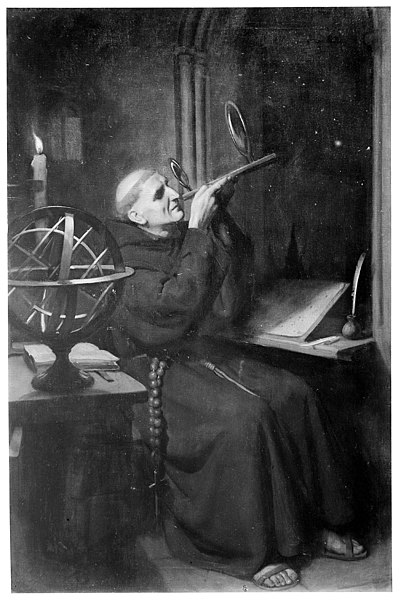
<div class='fn'> Roger Bacon in his observatory at Merton College, Oxford. Oi</div>





The Genesis of Empirical Inquiry in the Medieval West
Roger Bacon (c. 1219/20 – c. 1292) stands as a towering figure in medieval intellectual history, a Franciscan friar whose philosophical and scientific pursuits challenged the prevailing scholastic traditions. His epithet, 'Doctor Mirabilis' (Wonderful Teacher), hints at his extraordinary intellect and his forward-thinking approach. Bacon was a true polymath, deeply engaged with theology, philosophy, languages, and the burgeoning sciences.
What set him apart was his profound emphasis on empiricism – the belief that knowledge is primarily derived from sensory experience and experimentation. While acknowledging the importance of established texts, Bacon argued vehemently for the necessity of direct observation and verification, a stance that positioned him as a crucial precursor to the modern scientific revolution. His work represents a pivotal moment where faith and scientific investigation began to intertwine in new and dynamic ways.
Ancient Wisdom and Experimental Verification
Bacon's intellectual journey was shaped by both the rich legacy of classical scholarship and his own critical engagement with it. He studied at a university, absorbing the quadrivium (arithmetic, geometry, astronomy, and music) and the trivium (grammar, logic, and rhetoric). However, his empirical investigations, particularly in optics, revealed discrepancies between Aristotelian theory and observed phenomena.
This realization was instrumental in his intellectual development, leading him to champion the experimental method as articulated by scholars like Ibn al-Haytham (Alhazen). Bacon's application of these principles was not merely theoretical; he actively sought to test hypotheses, believing that 'experimental knowledge' was superior to knowledge gained solely through textual authority. This commitment to empirical validation, even when it contradicted established doctrines, was a radical departure for his era.
The Enduring Significance of Bacon's Scientific Advocacy
Roger Bacon's most profound impact lies in his role as an early and vocal advocate for the scientific method. His insistence on empirical testing as the cornerstone of reliable knowledge fundamentally shifted the intellectual landscape. He argued that understanding the world required active investigation, not passive acceptance of ancient texts.
This perspective was crucial in moving European thought away from purely deductive reasoning towards inductive reasoning based on observation. Beyond methodology, Bacon made concrete contributions, notably being the first in Europe to document the formula for gunpowder, a discovery with immense technological and military implications. His work also influenced educational reform, pushing for the inclusion of subjects like optics in university curricula, thereby broadening the scope of academic study beyond traditional philosophical and theological domains.
Foresight and the 'Opus Majus'
Bacon's magnum opus, the 'Opus Majus,' compiled in 1267 at the request of Pope Clement IV, serves as a testament to his encyclopedic knowledge and visionary thinking. This extensive work covered a vast array of subjects, including mathematics, astronomy, geography, alchemy, and the study of language and the senses. Within its pages, Bacon outlined concepts that were remarkably prescient, describing potential inventions such as flying machines, mechanical vehicles, and devices for underwater exploration.
His detailed analysis of optics, including the properties of lenses, laid theoretical groundwork for future advancements in telescopes and microscopes. While some of his 'experimental' knowledge was drawn from existing texts, his genius lay in synthesizing this information and advocating for its empirical verification and practical application, pushing the boundaries of medieval scientific thought.
A Legacy of Intellectual Courage and Methodological Innovation
Roger Bacon's legacy is that of an intellectual pioneer who dared to question established norms and champion a more rigorous, evidence-based approach to understanding the universe. He demonstrated that scientific inquiry and religious devotion were not mutually exclusive but could, in fact, complement each other. His emphasis on the importance of direct observation and experimentation, though sometimes limited by the technological capabilities of his time, provided a crucial intellectual foundation for the scientific revolution that would follow centuries later.
While later eras sometimes mythologized him as a sorcerer, his true significance lies in his methodical approach and his unwavering belief in the power of human reason and empirical investigation to unlock the secrets of the natural world.
See also
Frequently Asked Questions
Who was Roger Bacon?+
Why is he called "Doctor Mirabilis"?+
What did Roger Bacon do with experiments?+
Did Roger Bacon discover anything useful?+
What is the Opus Majus?+
Based on content from Wikipedia · Licensed under CC BY-SA 4.0