

Rainbow
Images
Rainbow
The Genesis of the Arc
Rainbows are a testament to the fundamental principles of light interacting with matter. The phenomenon originates from the optical properties of water droplets suspended in the atmosphere. When sunlight, a composite of electromagnetic waves across various wavelengths, encounters a spherical water droplet, it undergoes refraction as it enters the droplet.
This bending of light is wavelength-dependent, meaning different colors (wavelengths) bend at slightly different angles. Subsequently, the light ray travels to the back of the droplet, where it undergoes internal reflection. Upon exiting the droplet, the light refracts once more.
This entire process, particularly the differential refraction, leads to the separation of white light into its constituent spectrum – a process known as dispersion. The resulting continuous spectrum of colors, from violet to red, forms the visible arc. The specific geometry dictates that a rainbow is always observed in the sky directly opposite the sun’s position relative to the observer.
Decoding the Primary and Secondary Arcs
The most commonly observed rainbow is the primary rainbow. Its formation involves a single internal reflection within the water droplet. Light enters, reflects once off the back surface, and refracts again upon exiting.
The angle at which the light exits the droplet relative to its incident path determines the rainbow's angular radius. For the primary rainbow, this angle is approximately 42 degrees for red light and 40 degrees for violet light. This difference in exit angles is why red appears on the outer edge (larger angle) and violet on the inner edge (smaller angle) of the primary arc.
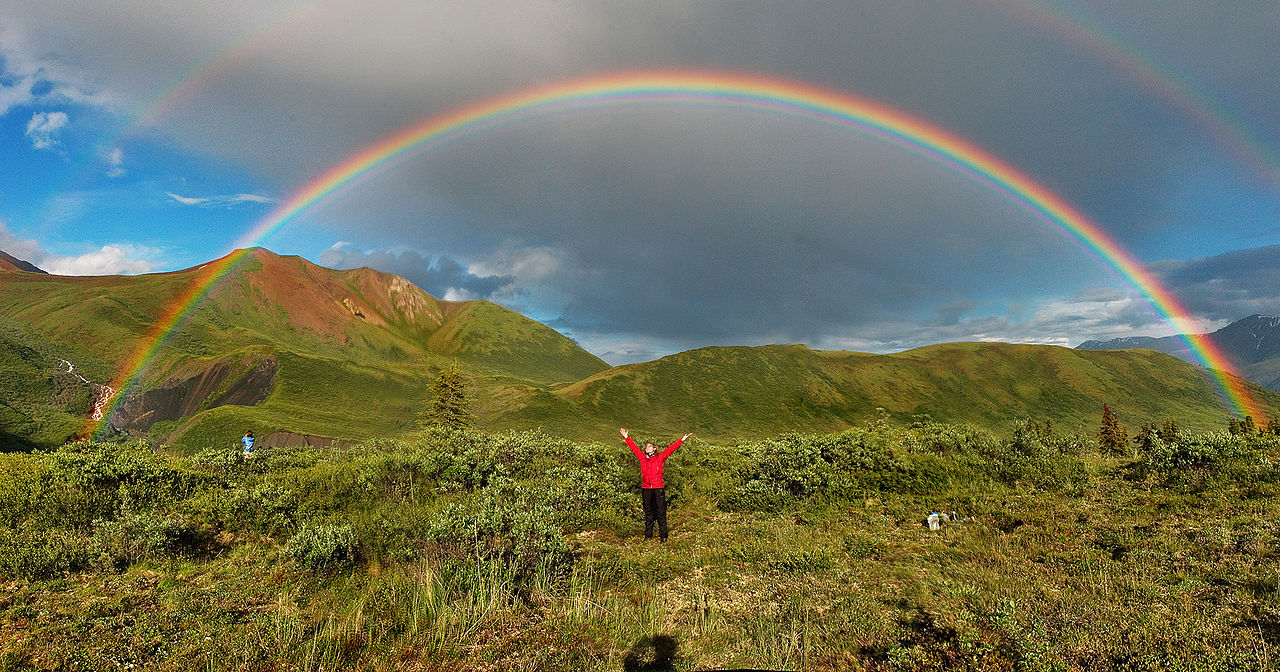
Above this, a secondary rainbow can sometimes be seen. This arc is formed by light that undergoes two internal reflections within the droplet. The double reflection causes the light to exit at a higher angle (around 51 degrees for red and 54 degrees for violet) and, critically, reverses the order of the colors.
Thus, the secondary rainbow displays violet on its outer edge and red on its inner edge, and it is generally fainter due to energy loss with each reflection.
Beyond Rain
While precipitation is the most frequent source of water droplets for rainbow formation, the phenomenon is not exclusive to rain showers. Any sufficiently dense concentration of airborne water particles can act as a medium for creating a rainbow, provided the observer is positioned correctly relative to the light source. This includes mist generated by waterfalls, sea spray along coastlines, and even the fine droplets from irrigation systems or fountains on a sunny day.
These 'non-standard' rainbow occurrences highlight that the fundamental requirement is the presence of a dispersed water medium and an appropriate angle of illumination. The observer’s eye acts as the apex of a cone, with the rainbow arc being the intersection of this cone with the collection of water droplets at the correct angles.
The Full Circle and Observer Dependence
It is a common misconception that rainbows are always semi-circular arcs. In reality, rainbows are complete circles. However, from the ground, the horizon typically obstructs the lower half of the circle, making it appear as an arc.
From a high vantage point, such as an airplane or a tall mountain, it is possible to observe a full circular rainbow. The center of the rainbow's circle is always located at the antisolar point – the point directly opposite the sun from the observer’s perspective. The rainbow is thus a personal phenomenon; each observer sees their own unique rainbow, determined by their specific position and the precise angle of the light rays from the water droplets that reach their eyes.
Go deeper
Frequently Asked Questions
What causes a rainbow?+
Why is the red color on the outside of a rainbow?+
What is a secondary rainbow?+
Can we see a rainbow without rain?+
Why do we usually see only half of a rainbow from the ground?+
Based on content from Wikipedia · Licensed under CC BY-SA 4.0