

Radium and radon in the environment
Images
Radium and radon in the environment
The Geochemical Origins of Environmental Radioactivity
Radium and radon are integral components of the Earth's natural radioactivity, primarily stemming from the decay chains of primordial radionuclides, notably uranium-238 and thorium-232. These long-lived isotopes, present since the formation of the planet, undergo a series of alpha and beta decays, ultimately producing a cascade of daughter isotopes, including radium and subsequently radon. Radium, existing as a solid alkaline earth metal, is typically found in trace amounts within igneous and metamorphic rocks, as well as in soils derived from them.
Its environmental mobility is generally low due to its solid state and chemical properties, but it can be mobilized through weathering processes or anthropogenic activities. Radon, a noble gas, is the direct gaseous progeny of radium. Its unique physical state allows it to readily diffuse from the soil and rock matrix into the atmosphere or groundwater.
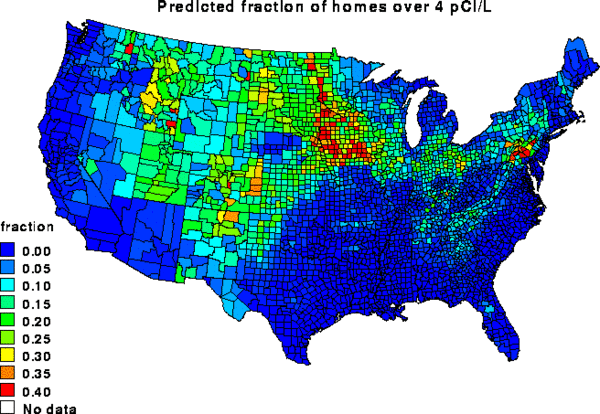
The concentration of radon in the environment is a complex interplay of geological factors (radon emanation rate from soil, uranium/thorium content), meteorological conditions (temperature, pressure, wind), and hydrological factors. Understanding these geochemical pathways is fundamental to assessing environmental exposure.
Historical Context and Anthropogenic Release
The discovery of radium by Marie and Pierre Curie in 1898 marked a pivotal moment in science, revealing an element with remarkable luminescent properties. This led to its widespread, albeit often ill-informed, application in consumer products throughout the early to mid-20th century, most famously in self-luminous paints for watch dials, instrument panels, and even novelty items. The 'Radium Girls' tragedy, where factory workers suffered severe health consequences from handling radioactive materials, starkly illustrated the dangers of radium exposure.
While natural sources remain dominant, anthropogenic releases of radium can occur through mining operations, the processing of uranium ores, and the improper disposal of radium-containing waste. The legacy of these past uses means that radium can still be found in legacy waste sites and contaminated soils, posing localized environmental risks. Radon's primary environmental pathway is natural emanation, but human activities like groundwater pumping can sometimes alter its distribution.
Environmental Significance and Health Risk Assessment
The environmental significance of radium and radon lies primarily in their contribution to ionizing radiation exposure for both humans and ecosystems. Radon is particularly noteworthy as it is estimated to be the second leading cause of lung cancer globally, after smoking, and the leading cause among non-smokers. This risk arises from the inhalation of radon gas and its short-lived decay products (polonium-218, lead-214, bismuth-214, polonium-214), which can deposit in the respiratory tract and emit alpha particles, causing cellular damage.
Radium exposure, typically through ingestion of contaminated water or soil, or inhalation of dust, can lead to bone cancer and other skeletal damage due to its tendency to deposit in bone tissue. Environmental regulations and public health initiatives focus on monitoring radon levels in indoor environments, as this is where the majority of human exposure occurs. Understanding dose-response relationships and establishing safe exposure limits are critical aspects of risk management.
Environmental Transport and Accumulation Mechanisms
The environmental behavior of radon is characterized by its gaseous nature, enabling significant transport and accumulation. Radon emanation from soil is influenced by factors such as soil moisture, temperature, and the presence of cracks or fissures, which facilitate gas diffusion. Atmospheric transport can disperse radon over wide areas, although its relatively short half-life (3.8 days) limits long-range travel.
The most significant accumulation occurs in enclosed spaces, such as residential buildings, where ventilation is inadequate. Buildings constructed on land with high radium concentrations in the soil, or those with basements that act as collection points, are particularly susceptible. Radon can enter buildings through foundation cracks, sumps, and utility penetrations.
Radium's environmental transport is more limited; it can be leached from soils into water bodies, where it can then be ingested by aquatic organisms or humans. Its presence in drinking water sources is a concern, necessitating monitoring and treatment in some areas. The interplay between geological release, atmospheric and hydrological transport, and human-made structures dictates the patterns of environmental exposure.
See also
Frequently Asked Questions
What is radium and where does it come from?+
How does radon get into our homes?+
Why is radon dangerous to breathe?+
Can radium be found in old paint or toys?+
How do scientists keep radon levels safe in homes?+
Based on content from Wikipedia · Licensed under CC BY-SA 4.0