

Quasar: The Universe's Brightest Lights!
Images
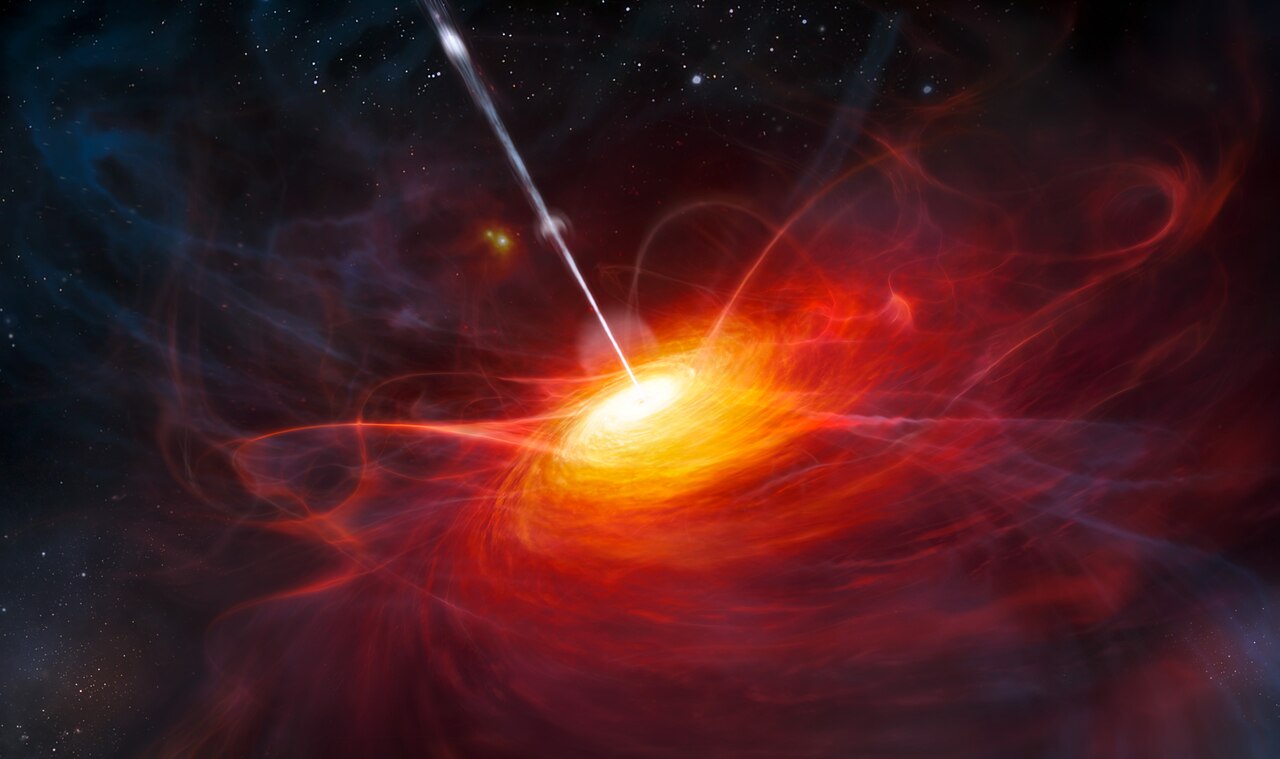
Quasar


The Genesis and Nature of Quasi-Stellar Objects
The term 'quasar' originated from 'quasi-stellar radio source,' reflecting their initial identification in the 1950s as point-like sources resembling stars but emitting strong radio waves. Their true nature remained enigmatic for years, appearing as faint, star-like objects in photographic surveys. High-resolution imaging, particularly from the Hubble Space Telescope, revolutionized our understanding, revealing that quasars are not stars but are situated at the centers of galaxies.
They are now classified as a subclass of active galactic nuclei (AGN), characterized by their immense luminosity. This luminosity is so profound that the most powerful quasars can outshine their host galaxies by thousands of times, making them detectable across vast cosmological distances. Their emission spans the electromagnetic spectrum, from radio waves to gamma rays, providing a rich source of astrophysical data.
Accretion Dynamics
The extraordinary energy output of quasars is driven by accretion onto a supermassive black hole (SMBH). These SMBHs possess masses ranging from millions to tens of billions of solar masses. As gas and dust from the host galaxy fall towards the black hole, they form an accretion disk.
Within this disk, intense gravitational forces and friction heat the material to extreme temperatures, often millions of degrees Celsius. This superheated plasma radiates profusely across the electromagnetic spectrum, generating the observed luminosity. The rate of accretion is a critical factor; higher accretion rates lead to more luminous quasars.
The presence and orientation of relativistic jets, powerful outflows of plasma ejected from the vicinity of the black hole, also significantly influence the observed properties and energy output of a quasar.
Cosmological Significance
Quasars serve as invaluable cosmological probes, offering a unique window into the early universe. Due to their extreme brightness, they can be observed at very high redshifts, corresponding to look-back times of over 13 billion years. This allows astronomers to study the universe when it was in its infancy, providing insights into the formation and evolution of the first galaxies and the growth of SMBHs.
The distribution of quasars reveals that their activity was significantly more common in the past, with a peak epoch around 10 billion years ago, suggesting a period of intense galaxy formation and black hole growth. The study of large quasar groups also hints at the potential existence of some of the largest structures in the universe, challenging our understanding of cosmic structure formation.
Observational Diversity and Host Galaxy Interactions
The observed characteristics of a quasar are multifaceted and depend on several factors. These include the mass of the central SMBH, the accretion rate, the viewing angle of the accretion disk relative to the observer, the presence or absence of powerful jets, and the degree of obscuration by gas and dust within the host galaxy. This variability means that quasars can appear quite different from one another.
Furthermore, high-resolution observations have confirmed that quasars reside in the centers of galaxies, and many host galaxies are observed to be undergoing strong interactions or mergers. These galactic encounters can funnel large amounts of gas towards the central SMBH, triggering or enhancing quasar activity. Understanding these complex interactions is key to comprehending the co-evolution of galaxies and their central black holes.
Go deeper
Frequently Asked Questions
What is a quasar?+
Why did early astronomers think quasars were stars?+
How do quasars produce so much energy?+
Where can we see quasars in the sky?+
Are quasars common today?+
Based on content from Wikipedia · Licensed under CC BY-SA 4.0