

Quantum Computer
Images

A quantum computing primer by Scott Aaronson


The Quantum Paradigm
Quantum computers represent a paradigm shift in computation, moving beyond the binary logic of classical computers. Instead of bits, they utilize quantum bits, or qubits. The power of qubits stems from quantum mechanical phenomena.
Superposition allows a qubit to exist in a combination of states (0 and 1) simultaneously, meaning an N-qubit system can represent 2^N states at once. This exponential increase in state space is the foundation for quantum parallelism. Furthermore, entanglement, a profound quantum correlation, links qubits such that their states are interdependent, enabling complex computational relationships.
These principles allow quantum computers to explore vast computational landscapes in parallel, offering a potential speedup for specific algorithms that is impossible for classical machines.
The Quantum Engine
The operational core of a quantum computer relies on manipulating qubits through quantum gates, analogous to logic gates in classical computing. Superposition is crucial, enabling qubits to hold multiple values concurrently. For instance, a 3-qubit system can represent all eight possible combinations (000 to 111) simultaneously.
Entanglement is equally vital, creating correlations that allow for sophisticated computations. When qubits are entangled, measuring one instantaneously influences the state of the others, no matter the physical separation. Quantum interference is another key principle, used to amplify the probability of correct answers and cancel out incorrect ones during computation.
These phenomena are delicate and require extreme isolation from environmental noise to maintain coherence.
Transformative Potential
The implications of functional quantum computers are profound and far-reaching. In medicine and materials science, they promise to revolutionize drug discovery and design by accurately simulating molecular interactions, a task currently intractable for even the most powerful supercomputers. This could lead to personalized medicine and novel materials with unprecedented properties.
In finance, quantum algorithms could optimize portfolios and risk analysis with greater speed and accuracy. Cryptography is another area facing significant disruption; Shor's algorithm, for example, can efficiently factor large numbers, posing a threat to current public-key encryption systems, thus driving the development of quantum-resistant cryptography. They also hold potential for advancements in artificial intelligence and complex optimization problems.
Genesis of an Idea
The conceptualization of quantum computing emerged from the foundational work in quantum mechanics. Early theoretical explorations by physicists like Paul Benioff and Yuri Manin in the late 1970s and early 1980s laid the groundwork. A pivotal moment arrived in 1982 when Richard Feynman proposed that a quantum computer could simulate quantum systems more efficiently than classical computers, highlighting its unique computational power.
This insight spurred further theoretical development and, crucially, the pursuit of practical implementation. Over the subsequent decades, numerous researchers and institutions have grappled with the immense engineering challenges of building stable, scalable quantum computers, leading to various qubit technologies like superconducting circuits, trapped ions, and topological qubits.
Current Landscape and Future Trajectory
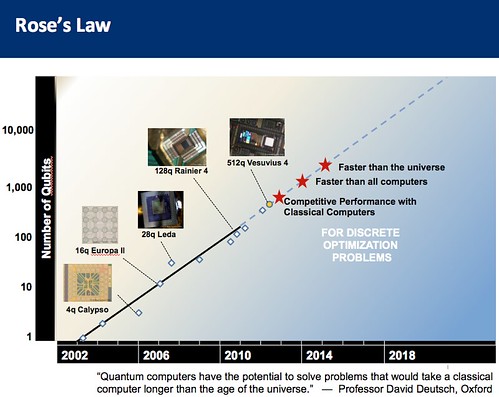
Today, quantum computing is an active field of research and development, with several companies and academic institutions building and experimenting with quantum processors. These systems, often referred to as Noisy Intermediate-Scale Quantum (NISQ) devices, possess tens to a few hundred qubits but are susceptible to errors due to their inherent fragility. Despite these limitations, NISQ computers are being used to explore quantum algorithms for specific applications, such as quantum chemistry simulations, optimization problems, and machine learning.
The ongoing quest is to achieve fault-tolerant quantum computation, which requires robust error correction mechanisms and a significantly larger number of high-quality qubits. The transition from NISQ to fault-tolerant quantum computing marks the next frontier, promising to unlock the full transformative potential of this technology.
See also
Frequently Asked Questions
What is a quantum computer?+
How do qubits work?+
Why are quantum computers faster than regular computers?+
What could quantum computers help us with?+
Who first thought about quantum computers?+
Based on content from Wikipedia · Licensed under CC BY-SA 4.0