

Puck: Uranus's Tiny Moon!
Images

Puck (moon)


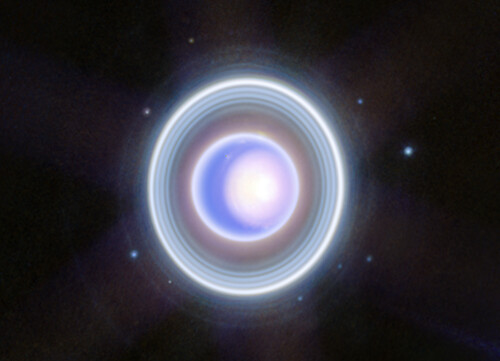


Puck's Place in the Uranian Satellite System
Puck is one of the inner moons of Uranus, orbiting the planet at a mean distance of approximately 86,000 kilometers. Its diameter is estimated to be around 162 kilometers, classifying it as a significant body within the inner Uranian system, though still far smaller than the larger moons like Titania or Oberon. Unlike these larger, more spherical moons, Puck possesses a distinctly irregular, non-spherical shape.
This morphology is characteristic of many smaller moons throughout the solar system and suggests that Puck's gravitational self-attraction is insufficient to overcome its material strength, a common trait for bodies below a certain size threshold. Its surface is notably dark, with a low albedo, indicating a composition that absorbs a significant portion of incident sunlight. This darkness is often attributed to the presence of carbonaceous compounds or tholins, complex organic molecules formed by the interaction of radiation with simple ices and hydrocarbons.
Orbital Dynamics and Formation Hypotheses
Puck's orbital period around Uranus is remarkably short, completing a full revolution in just over 18 hours. This rapid orbit places it well within the planet's magnetosphere and contributes to its dynamic environment. The close proximity and swift motion are key factors in understanding its interaction with Uranus's gravitational field and potential tidal forces.
The irregular shape and dark surface of Puck have led to several hypotheses regarding its origin. One possibility is that it is a remnant from the accretion disk that formed Uranus's larger moons, a piece that never grew large enough to become spherical. Another compelling theory is that Puck is a captured asteroid or comet nucleus that was subsequently incorporated into the Uranian system.
The presence of ice and rock suggests it formed in a region where both materials were abundant. Studying Puck's composition and shape helps astronomers refine models of satellite formation, particularly in the frigid outer solar system where conditions differ significantly from those closer to the Sun.
The Voyager 2 Revelation and Ongoing Study
The discovery of Puck in 1985 by the Voyager 2 spacecraft was a pivotal moment in our understanding of Uranus's satellite system. Prior to Voyager 2's flyby, only the five largest moons of Uranus were known. The spacecraft's high-resolution imaging capabilities revealed Puck and several other smaller inner moons, dramatically expanding the known satellite population.
Voyager 2 provided the first detailed images of Puck, showcasing its irregular shape and dark, cratered surface. These images were crucial for initial scientific analysis, allowing for estimates of its size, shape, and surface features. While no subsequent missions have visited Puck, its existence and characteristics continue to inform broader studies of planetary rings and moon formation.
Its dark nature and irregular shape make it a valuable case study for understanding the processes that shape smaller celestial bodies in the outer solar system.
Significance and Future Exploration
Puck, despite its small size, holds significant scientific value. As one of the inner moons of Uranus, it plays a role in the complex gravitational interactions within the Uranian system, potentially influencing the dynamics of the planet's faint rings. Its irregular shape and dark composition provide clues about the early stages of planetary system formation and the processes of accretion and collision in the outer solar system.
Understanding bodies like Puck helps scientists piece together the evolutionary history of Uranus and its satellites, offering a comparative perspective against the more extensively studied systems of Jupiter and Saturn. Future exploration missions to Uranus, if funded, would undoubtedly target these inner moons for closer study, potentially revealing more about their internal structure, surface composition, and origin. Such missions could provide definitive answers about whether Puck is a primordial remnant or a captured object, further enriching our understanding of planetary science.
See also
Based on content from Wikipedia · Licensed under CC BY-SA 4.0