

Positron
Images
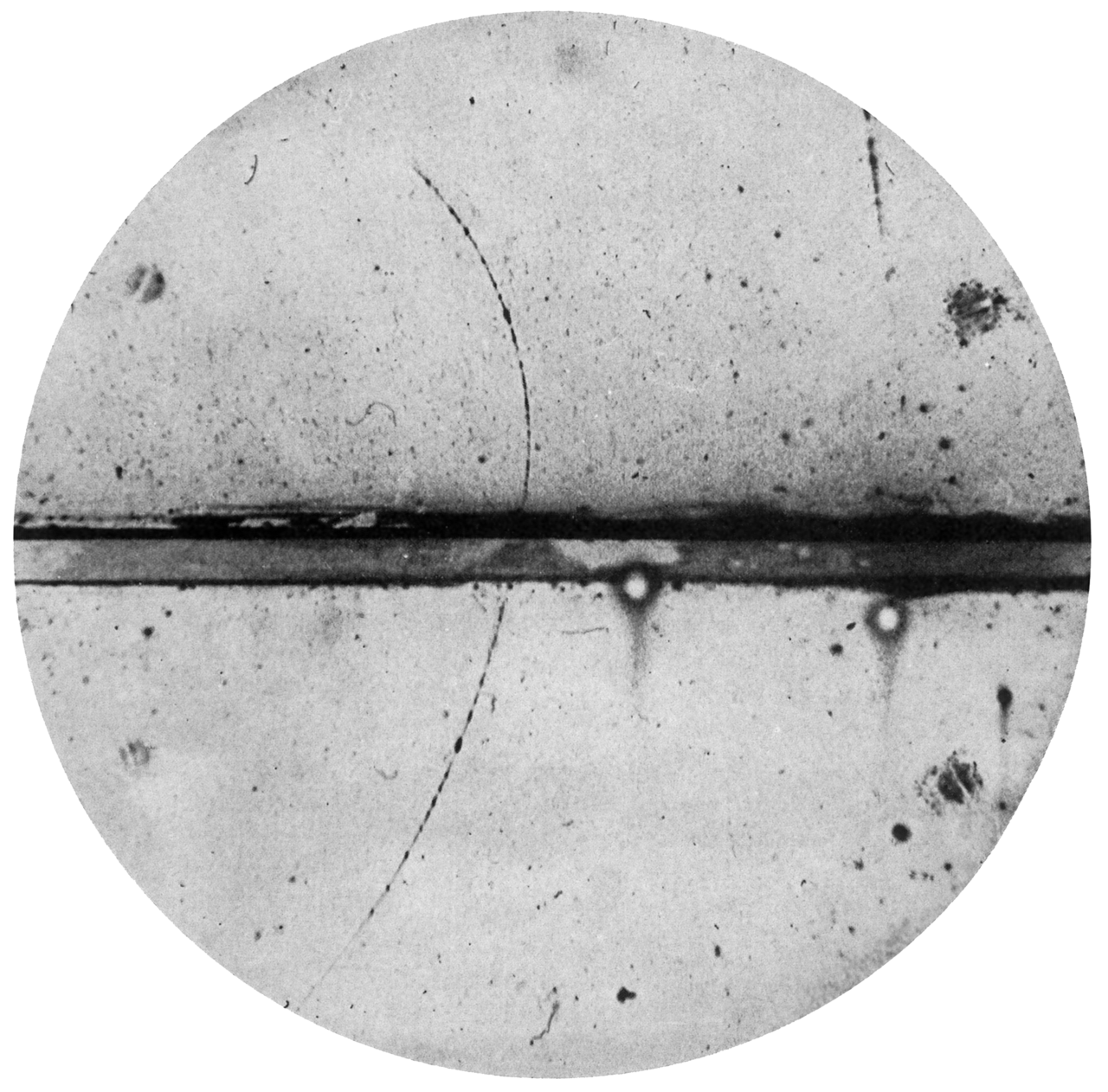
Positron


The Positron
The positron, denoted as e+ or β+, is the antiparticle of the electron (e-). It shares the electron's mass (approximately 9.109 x 10^-31 kg) but possesses an equal and opposite electric charge (+1.602 x 10^-19 C). As a fundamental lepton, it is not composed of smaller particles.
The concept of antimatter was first theorized by physicist Paul Dirac in 1928 as a consequence of his relativistic quantum mechanical equation for the electron, which predicted the existence of a particle with the electron's mass but positive charge. The positron's discovery provided the first experimental confirmation of antimatter, revolutionizing our understanding of fundamental physics and the symmetry of the universe. Its existence implies that for every type of matter particle, there is a corresponding antiparticle.
Discovery and Early Investigations
The positron was experimentally discovered in 1932 by Carl D. Anderson while he was studying the tracks of cosmic rays in a Wilson cloud chamber. He observed a particle track that was identical to that of an electron in terms of ionization and mass (deduced from its curvature in a magnetic field), but it deflected in the opposite direction, indicating a positive charge.
This groundbreaking observation, for which Anderson later received the Nobel Prize in Physics, validated Dirac's theoretical predictions and marked a pivotal moment in particle physics. Subsequent research, including work by Patrick Blackett and Giuseppe Occhialini, further confirmed the positron's properties and its origin from high-energy interactions, such as those involving gamma rays.
Annihilation Dynamics
The most significant characteristic of the positron, and indeed all antimatter, is its propensity for annihilation upon contact with its matter counterpart. When a positron encounters an electron, they annihilate each other, converting their entire rest mass into energy, typically in the form of two or more high-energy photons (gamma rays). This process is governed by Einstein's famous equation E=mc², where the combined mass of the electron and positron is transformed into energy.
The minimum energy released is 2mc², corresponding to two photons of 511 keV each, traveling in opposite directions to conserve momentum. This annihilation process is highly efficient and is a fundamental interaction studied in quantum electrodynamics (QED). The detection of these characteristic gamma rays is a key method for identifying positron activity.
Applications and Significance
The positron's unique properties have led to indispensable applications, most notably in medical imaging. Positron Emission Tomography (PET) scans utilize radioisotopes that decay by positron emission. When these positrons are emitted within the body, they quickly annihilate with nearby electrons in tissues, producing pairs of 511 keV gamma rays. These gamma rays are detected by the PET scanner, allowing for the reconstruction of a 3D image that maps the distribution of the radioisotope.
This technique is vital for diagnosing and monitoring a wide range of conditions, including cancers, neurological disorders, and cardiovascular diseases. Beyond medicine, positrons are crucial tools in fundamental physics research, used in experiments to study particle interactions, material science, and even in the development of particle accelerators.
The Broader Implications
The discovery of the positron opened the door to the study of antimatter and raised profound questions about the universe's composition. The Big Bang theory suggests that matter and antimatter should have been created in equal amounts, yet the observable universe is overwhelmingly composed of matter. This asymmetry, known as baryogenesis, is one of the greatest unsolved mysteries in physics.
Understanding the properties and behavior of antiparticles like the positron is essential for unraveling this puzzle. Future research may explore more advanced applications, such as antimatter-based propulsion or novel therapeutic approaches, though the challenges of producing and storing antimatter remain significant. The positron continues to be a cornerstone in our quest to comprehend the fundamental laws of nature.
Go deeper
Based on content from Wikipedia · Licensed under CC BY-SA 4.0