

Poisson distribution
Images
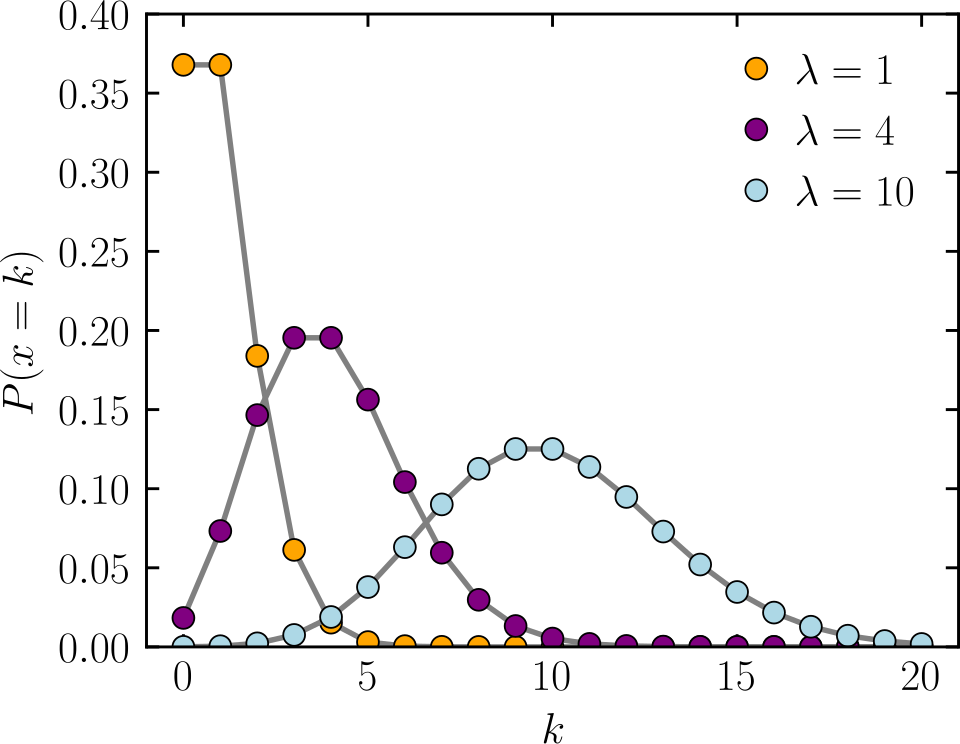
Poisson distribution
The Mathematical Foundation of Discrete Randomness
The Poisson distribution is a fundamental discrete probability distribution that models the probability of a given number of events occurring in a fixed interval of time or space, provided these events occur with a known constant mean rate and independently of the time since the last event. Its probability mass function is given by P(X=k) = (λ^k * e^-λ) / k!, where 'k' is the number of occurrences, 'λ' (lambda) is the average rate of occurrences (the mean), and 'e' is Euler's number (approximately 2.71828).
This formula allows us to calculate the likelihood of observing exactly 'k' events, from zero upwards. It's particularly powerful for situations where events are relatively rare compared to the total number of opportunities for them to occur. The distribution is characterized by a single parameter, λ, which represents both its mean and its variance, a unique property that distinguishes it from other distributions.
Historical Roots
The distribution bears the name of Siméon Denis Poisson, a French mathematician, physicist, and engineer, who introduced it in his 1837 work 'Recherches sur la probabilité des jugements en matière criminelle et en matière civile' (Research on the Probability of Judgments in Criminal and Civil Matters). However, the concept of modeling rare events had precursors. For instance, in 1815, Siméon Denis Poisson himself used it to analyze the number of deaths caused by horse kicks in the Prussian army, a classic example of a rare event occurring over time.
Later, Ladislaus Bortkiewicz independently derived the distribution and applied it to analyze the number of deaths from spontaneous combustion in the Prussian army, further solidifying its utility. This historical application highlights the distribution's early success in modeling infrequent, seemingly random occurrences in empirical data.
The Indispensable Role of Poisson in Modern Analysis
The significance of the Poisson distribution extends across numerous scientific and industrial domains. In telecommunications, it's crucial for call center management, network traffic analysis, and predicting the number of data packets lost. In quality control, it helps estimate the number of defects per unit area or volume, informing production processes. Astrophysics utilizes it to count celestial objects like galaxies or supernovae within specific observational windows.
In biology and medicine, it models the number of mutations in DNA, the occurrence of diseases in a population, or the count of cells under a microscope. Its application in queuing theory is fundamental for analyzing waiting lines, from supermarket checkouts to computer system processes. Essentially, anywhere discrete, rare events need to be quantified and understood, the Poisson distribution provides an essential analytical framework.
Mechanism and Properties
The Poisson distribution is intrinsically linked to the concept of a Poisson process, which describes a sequence of random events occurring over time or space. For a process to be Poisson, three conditions must generally be met: 1. Events are independent: the occurrence of one event does not influence the probability of another. 2.
The average rate (λ) is constant: the probability of an event occurring in a small interval is proportional to the length of the interval. 3. Two events cannot occur at precisely the same instant. The Poisson distribution arises as the limiting case of the binomial distribution when the number of trials 'n' approaches infinity and the probability of success 'p' approaches zero, such that the product 'np' (which is λ) remains constant.
This connection underscores its role in modeling rare events in large populations or over extended periods.
Advanced Applications and Connections
Beyond its direct applications, the Poisson distribution serves as a building block for more complex statistical models. It's often used as an approximation for the binomial distribution when 'n' is large and 'p' is small, simplifying calculations. It also forms the basis for the exponential distribution, which models the time between events in a Poisson process.
In fields like actuarial science, it's used to model the frequency of insurance claims. In computational biology, it can model gene duplication events. Furthermore, the Poisson distribution is a key component in understanding and developing models for phenomena like customer arrivals, equipment failures, and even the distribution of stars in the sky, demonstrating its pervasive influence in statistical modeling and data analysis.
See also
Based on content from Wikipedia · Licensed under CC BY-SA 4.0