

Plutino: Tiny Worlds in the Cosmic Neighborhood!
Images

Plutino-orbits with 2017OF69


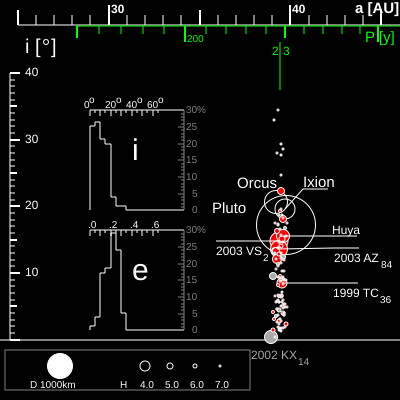


The 2:3 Resonance
Plutinos represent a dynamically distinct population within the Kuiper Belt, characterized by their stable 2:3 mean-motion resonance with Neptune. This orbital configuration dictates that for every two sidereal orbital periods of a plutino, Neptune completes precisely three. This resonance is not merely a statistical curiosity; it is a powerful gravitational interaction that sculpts the architecture of the outer solar system.
The resonance acts as a protective mechanism, preventing plutinos from undergoing chaotic orbital evolution that might otherwise lead to collisions with Neptune or ejection from the solar system. The stability of this resonance over billions of years is a testament to the enduring influence of Neptune's gravity. This dynamical grouping is crucial for understanding the distribution and survival of objects in the Kuiper Belt, as it creates stable orbital 'lanes' where such bodies can persist.
The prevalence of plutinos, estimated to be around a quarter of all known Kuiper Belt objects, underscores the significance of this resonance in shaping the demographics of the outer solar system.
Mythological Echoes
The nomenclature applied to plutinos reflects a deliberate connection between scientific discovery and ancient cultural narratives. The group is named after Pluto, the Roman god of the underworld, who also lends his name to the most prominent member, the dwarf planet Pluto. This choice is fitting, as these objects reside in the distant, dimly lit regions of the solar system, akin to the mythological underworld.
Beyond Pluto, other significant plutinos like Orcus, Ixion, and Achlys are named after deities and figures from various mythologies associated with death, the afterlife, or the underworld. This practice serves not only to honor these ancient stories but also to provide a consistent and evocative theme for classifying these celestial bodies. The naming convention highlights a broader trend in astronomy, where scientific exploration is often intertwined with human history and mythology, creating a rich tapestry of understanding.
Demographics of the Outer Solar System
Plutinos occupy a critical position within the Kuiper Belt, forming the inner boundary of this vast reservoir of icy bodies. Their significance extends beyond their orbital dynamics; they represent the most populous known class of resonant trans-Neptunian objects. This dominance suggests that the conditions prevalent during the formation and early evolution of the solar system were particularly conducive to the creation and long-term survival of objects in this specific resonant configuration.
The discovery of the first plutino after Pluto, (385185) 1993 RO, on September 16, 1993, marked a pivotal moment, initiating a deeper investigation into this population. Their abundance provides invaluable data for refining models of planetary migration and the accretion processes that occurred in the protoplanetary disk. Understanding the plutino population is therefore essential for comprehending the overall structure and composition of the Kuiper Belt and, by extension, the broader dynamics of planetary system formation.
Scientific Significance
The scientific importance of plutinos cannot be overstated. As primordial remnants from the early solar system, they are essentially frozen archives of the conditions that existed during planetary formation. Their composition, often inferred from spectroscopic analysis, can reveal details about the volatile materials present in the outer solar system nebula.
Furthermore, their stable resonant orbits provide a unique natural laboratory for testing theories of orbital dynamics and long-term gravitational stability. The presence of plutinos in such significant numbers suggests that Neptune's migration, a key event in solar system formation models, played a crucial role in scattering and capturing these objects into their resonant states. Studying plutinos allows astronomers to reconstruct the history of Neptune's outward movement and its impact on the Kuiper Belt's architecture.
Ultimately, these distant icy bodies offer a tangible link to the solar system's nascent stages, providing critical data for understanding the origins of planets and the processes that govern their evolution.
Broader Implications
The study of plutinos and their resonant dynamics has profound implications that extend beyond our own solar system. Understanding how Neptune's gravity has shaped the Kuiper Belt and maintained these resonant populations provides a template for investigating exoplanetary systems. The principles of orbital resonance are universal, and observing such stable configurations in our own outer solar system helps astronomers identify similar patterns in distant planetary systems.
This knowledge aids in the detection and characterization of exoplanets, particularly those in the outer regions of their stellar systems. Moreover, the existence of a large, stable population of objects like plutinos suggests that similar belts of trans-Neptunian objects might be common around other stars. This informs the search for potentially habitable worlds and the understanding of planetary system diversity across the galaxy.
Plutinos, therefore, serve as both historical records and predictive models for cosmic exploration.
See also
Frequently Asked Questions
What is a plutino?+
Why do plutinos stay safe from crashing into Neptune?+
How many of the Kuiper Belt objects are plutinos?+
Why are plutinos named after Pluto and other mythological figures?+
When was the first plutino discovered?+
Based on content from Wikipedia · Licensed under CC BY-SA 4.0