

The Plum Pudding Atom!
Images

Plum pudding quantum dot


Thomson's Postulate
J.J. Thomson's Plum Pudding Model, introduced in 1904, represented a significant theoretical leap following his groundbreaking discovery of the electron in 1897. At a time when the atom was largely considered an indivisible entity, Thomson proposed a structure that accounted for the newly identified electron.
His model depicted the atom as a sphere of uniform positive charge, within which negatively charged electrons were embedded. The distribution of these electrons was envisioned as somewhat random, analogous to raisins in a pudding or plums in a cake, hence the popular moniker. The core principle was electrical neutrality: the total positive charge of the diffuse sphere was precisely equal to the sum of the negative charges of the embedded electrons.
This was the simplest mathematical hypothesis that could reconcile the existence of electrons with the observed electrical neutrality of atoms, offering a tangible, albeit incorrect, visualization of atomic composition.
The Model's Conceptual Significance and Limitations
The Plum Pudding Model's historical importance cannot be overstated. It was the first model to propose that atoms possessed internal structure and were composed of smaller subatomic particles. This fundamentally shifted the scientific paradigm from indivisible atoms to complex entities.
It provided a conceptual framework for understanding atomic mass distribution and electrical balance, stimulating further inquiry into the atom's constituents. However, the model suffered from critical limitations. It failed to adequately explain phenomena such as the discrete emission spectra of elements and the chemical properties of atoms, including valency.
Furthermore, Thomson's assumption of a diffuse positive charge lacked experimental verification and proved incompatible with subsequent discoveries about the atom's core.
Mechanisms and Analogies
Within Thomson's model, the electrons were not static but were assumed to be in motion. They were envisioned as oscillating within the positive sphere, repelling each other due to their like charges, yet simultaneously being attracted towards the center of the positive charge. Thomson's conception of the positive charge was not as a rigid structure but as a fluid medium, allowing for this dynamic interplay of forces.
This fluid analogy was key to his mathematical treatment, aiming to find stable configurations for the electrons. The popular 'plum pudding' analogy, while effective for layman comprehension, was perhaps misleading. Neither Thomson nor his contemporaries used this term; it was coined later by popular science writers.
The analogy implies a solid matrix, whereas Thomson conceived of a more fluid positive charge distribution.
Superseded by the Nuclear Model
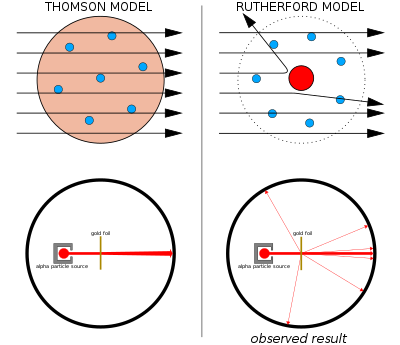
The Plum Pudding Model's reign as the leading atomic theory was definitively ended by Ernest Rutherford's famous gold foil experiment in 1911. In this experiment, alpha particles were fired at a thin sheet of gold foil. While most particles passed straight through, as predicted by Thomson's diffuse model, a small fraction were deflected at large angles, and some even bounced back.
Rutherford famously remarked that it was 'quite the most incredible event that has ever happened to me in my life. It was almost as incredible as if you fired a 15-inch shell at a piece of tissue paper and it came back and hit you.' This led Rutherford to propose his nuclear model, where the atom's positive charge and most of its mass are concentrated in a tiny, dense nucleus at the center, with electrons orbiting at a distance. This discovery rendered the Plum Pudding Model obsolete, highlighting the limitations of a diffuse positive charge and ushering in a new era of atomic physics.
See also
Frequently Asked Questions
What was the Plum Pudding Model of the atom?+
Why did scientists call it the "plum pudding" model?+
How did the Plum Pudding Model explain electrical neutrality?+
Why did the Plum Pudding Model fail?+
How did Rutherford's gold foil experiment change the idea of the atom?+
Based on content from Wikipedia · Licensed under CC BY-SA 4.0