

Pion
Images

Quark model of nucleon-pion interaction


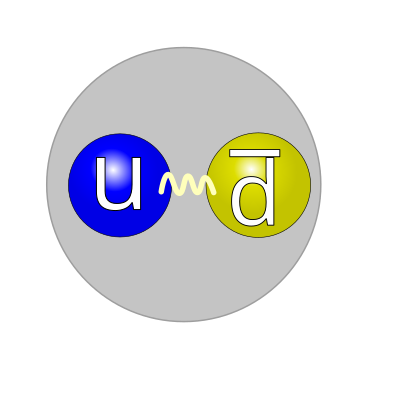
The Pion
The pion, denoted by the Greek letter π, represents a pivotal particle in the Standard Model of particle physics. It exists in three charge states: the neutral π0, and the positively and negatively charged π+ and π−. Each pion is classified as a meson, a composite particle formed by a quark and its corresponding antiquark.
Specifically, pions are composed of the up (u) and down (d) quarks and their antiparticles. The π+ is a ūd, the π− is a d̄u, and the π0 is a superposition of ūu and d̄d. This composition makes pions the lightest mesons and, more broadly, the lightest hadrons.
Their ephemeral nature is a defining characteristic: charged pions (π±) have a mean lifetime of approximately 26.033 nanoseconds, decaying predominantly into a muon and a muon neutrino. The neutral pion (π0) has a dramatically shorter lifetime, around 85 attoseconds, decaying primarily into two gamma rays. This rapid decay underscores their role as transient carriers of fundamental forces.
Yukawa's Meson Theory and the Nuclear Force
The theoretical significance of the pion was first recognized by Hideki Yukawa in 1935. He proposed the existence of a particle mediating the strong nuclear force that binds protons and neutrons within the atomic nucleus. This force, much stronger than the electromagnetic repulsion between protons, needed a carrier particle.
Yukawa predicted a mass for this mediator that fell between that of the electron and the proton, a description that remarkably matched the properties of the pion when it was later discovered. The exchange of virtual pions between nucleons (protons and neutrons) provides a powerful explanation for the residual strong force. While not the fundamental strong force described by Quantum Chromodynamics (QCD), which is mediated by gluons, pion exchange accurately describes the force at the distances relevant to atomic nuclei.
This historical context highlights the pion's foundational role in our understanding of nuclear physics.
Pion Production
Pions are not typically produced through radioactive decay but are commonly generated in high-energy interactions. In particle accelerators, physicists collide hadrons (particles made of quarks, like protons) at extremely high energies, leading to the creation of numerous pions. They also arise from matter-antimatter annihilation events.
On a cosmic scale, pions are abundantly produced when high-energy cosmic rays, primarily protons, interact with the Earth's atmosphere. Furthermore, observations of gamma rays from supernova remnants have provided compelling evidence that pions are copiously generated in these cataclysmic stellar explosions. This production is strongly linked to the acceleration of protons to cosmic ray energies, making pions crucial tracers of extreme astrophysical environments and particle acceleration mechanisms.
Astrophysical Implications
The existence and decay of pions have profound implications for astrophysics. The Greisen–Zatsepin–Kuzmin (GZK) limit is a direct consequence of pion production. As ultra-high-energy cosmic rays (primarily protons) travel across the vast distances of the universe, they interact with the cosmic microwave background (CMB) photons.
If a proton's energy exceeds the GZK threshold, it will collide with a CMB photon and produce a pion, losing significant energy in the process. This interaction effectively imposes an upper limit on the energy of cosmic rays that can reach Earth from distant sources. The detection of characteristic gamma-ray signatures from neutral pion decay in supernova remnants offers a direct probe into the particle acceleration processes occurring in these events, helping us understand the origin of galactic and extragalactic cosmic rays and the extreme physics at play in the universe.
See also
Frequently Asked Questions
What is a pion?+
How many kinds of pions are there?+
How long does a pion last before it decays?+
Where do pions come from?+
Why are pions important in science?+
Based on content from Wikipedia · Licensed under CC BY-SA 4.0