

Pico Bolívar
Images

Frailejones (Espeletia sp.) on Pico Bolívar foothills ...


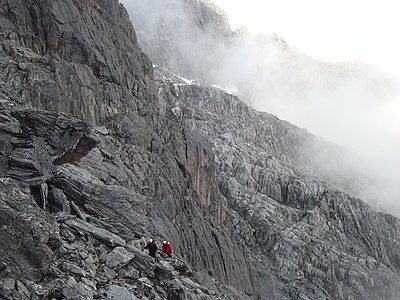


Geomorphology and Climate of Venezuela's Highest Peak
Pico Bolívar, with its imposing altitude of 4,978 meters (16,332 feet), represents the zenith of Venezuela's topography, situated within the rugged Sierra Nevada de Mérida range in Mérida State. This stratovolcano, though dormant, is characterized by its dramatic glacial cirques and sharp arêtes, sculpted by millennia of ice action. The summit is perpetually capped with snow and ice, a testament to the extreme alpine climate.
Temperatures at this elevation rarely rise above freezing, and the region experiences significant snowfall and harsh winds. The surrounding landscape is a high-altitude páramo ecosystem, featuring unique flora adapted to the cold, thin air and intense solar radiation. Its geological neighbors, El León (4,743 m) and El Toro (4,695 m), further emphasize the mountainous grandeur of the region.
The challenging terrain and extreme weather conditions make Pico Bolívar a formidable natural barrier and a significant geographical landmark.
Historical Evolution of a Name
The mountain now known as Pico Bolívar has a history tied to both its physical form and national identity. Originally referred to as La Columna, its name was a descriptive reference to its imposing stature. The pivotal shift in its nomenclature occurred in 1925 when Tulio Febres Cordero proposed renaming it in honor of Simón Bolívar, the pivotal figure in South American independence.
This proposal was officially adopted on December 30, 1934, transforming the mountain into a living monument to the liberator. This renaming was more than symbolic; it was a deliberate act to imbue a prominent natural feature with national historical significance, linking the country's highest point to its foundational hero and the ideals of freedom and sovereignty he championed. The mountain thus serves as a constant, visible reminder of Venezuela's struggle and triumph.
The Ascent
The journey to Pico Bolívar's summit is a testament to human endurance and mountaineering skill, as it is accessible solely through trekking. While the Mérida cable car system, a marvel of engineering that once held world records for its length and height, provides access to Pico Espejo, it does not extend to the ultimate peak. From Pico Espejo, climbers face a demanding route that requires technical climbing skills, acclimatization to high altitude, and a deep understanding of alpine conditions.
The ascent typically involves navigating steep ice walls and rocky outcrops, often under adverse weather. This arduous path ensures that only experienced and well-prepared mountaineers can achieve the summit, making the accomplishment a significant personal achievement and a highlight for adventure tourism in Venezuela, showcasing the country's potential for extreme sports.
Pico Bolívar
Pico Bolívar transcends its status as a mere geographical high point; it functions as a profound national symbol, deeply interwoven with Venezuela's identity and history. Its sheer height and majestic presence in Mérida State evoke a sense of national pride and aspiration. The renaming in honor of Simón Bolívar solidifies its role as a tribute to the country's liberator and the revolutionary spirit.
For many Venezuelans, the mountain represents resilience, strength, and the enduring pursuit of national ideals. Furthermore, its challenging ascent attracts international mountaineers, positioning Venezuela as a destination for adventure and highlighting the country's unique natural heritage on a global scale. It serves as a constant reminder of the nation's grandeur, both geographically and historically.
Socio-Economic and Educational Context of the Mérida Region
While Pico Bolívar itself is a natural monument, its existence is intrinsically linked to the socio-economic and educational landscape of Mérida State. The region's economy is significantly influenced by tourism, with Pico Bolívar and the surrounding Sierra Nevada National Park drawing visitors interested in hiking, mountaineering, and ecotourism. This tourism supports local businesses, from guiding services to accommodations.
Mérida State is also a prominent educational hub in Venezuela, home to the Universidad de Los Andes (ULA), one of the country's leading universities. This academic presence fosters research in fields like environmental science and geography, contributing to the understanding and conservation of the region's unique ecosystems. Educational initiatives often focus on the importance of natural resource management and the cultural heritage associated with the mountains, including the legacy of Simón Bolívar, thereby connecting scientific inquiry with national identity and economic development.
See also
Frequently Asked Questions
What is Pico Bolívar?+
Why is it called Pico Bolívar?+
How can you reach the summit of Pico Bolívar?+
What kind of climate does Pico Bolívar have?+
What does Pico Bolívar mean to Venezuelans?+
Based on content from Wikipedia · Licensed under CC BY-SA 4.0