

Photoelectric Effect
Images
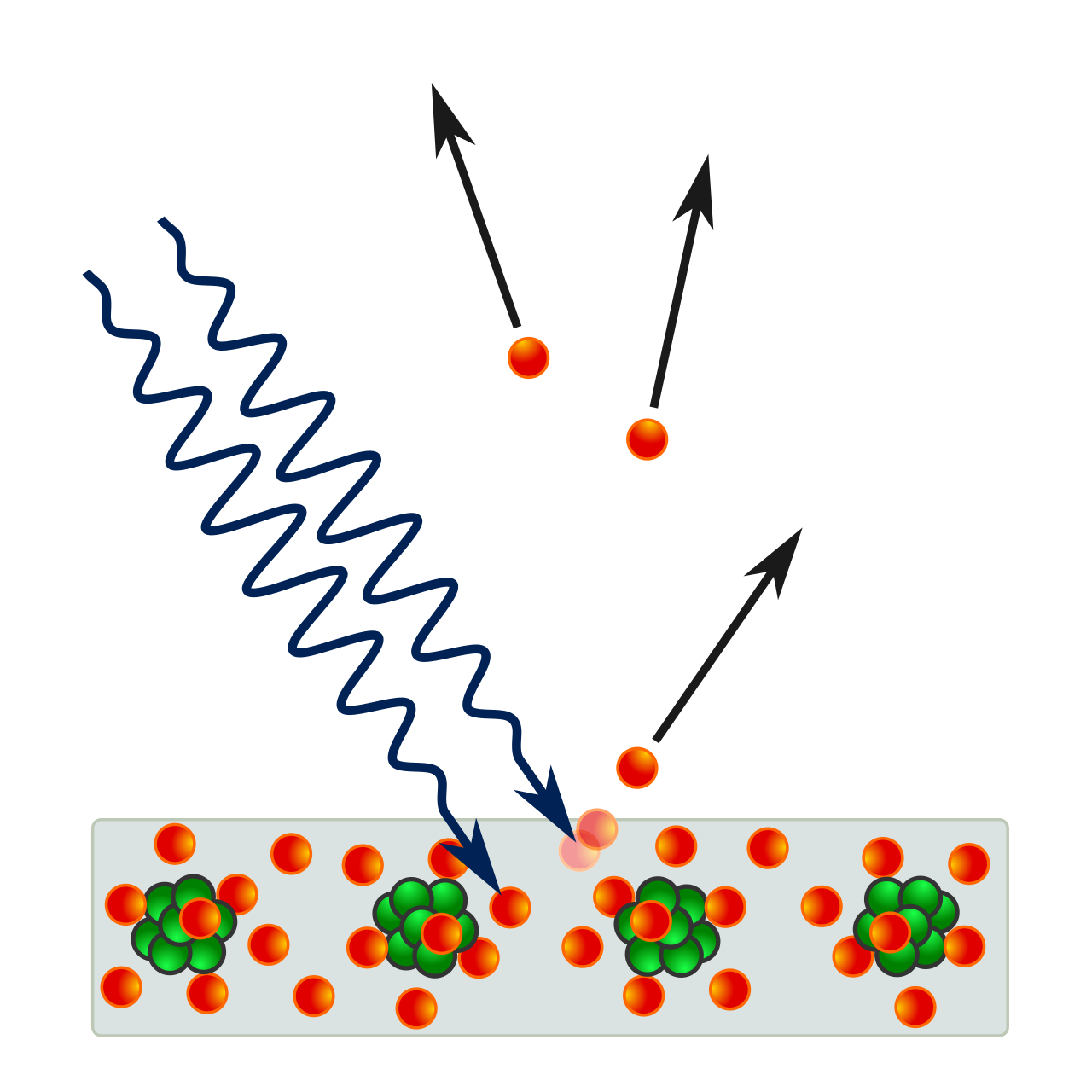
Photoelectric effect


Light's Dual Nature and Electron Ejection
The photoelectric effect is a fundamental quantum mechanical phenomenon where electrons are emitted from a material when light of sufficient frequency shines upon it. This emission is not a gradual process; it occurs instantaneously once the incident light's photons possess enough energy to overcome the material's work function. The classical wave theory of light struggled to explain key observations: the existence of a threshold frequency below which no emission occurs regardless of light intensity, and the immediate emission of electrons when the frequency is above the threshold, irrespective of intensity.
This discrepancy highlighted a profound limitation in classical physics and paved the way for a revolutionary understanding of light.
Einstein's Nobel-Winning Insight
Albert Einstein's groundbreaking 1905 paper on the photoelectric effect provided the definitive explanation, earning him the Nobel Prize in Physics in 1921. He proposed that light energy is not continuous but is quantized into discrete packets, or 'quanta,' which he later termed photons. The energy of a single photon is directly proportional to the frequency of the light, given by the equation E = hf, where 'h' is Planck's constant and 'f' is the frequency.
When a photon strikes an electron in the material, it transfers its entire energy. If this photon energy (hf) is greater than the material's work function (Φ), the electron is ejected. The excess energy (hf - Φ) becomes the kinetic energy of the emitted electron.
This particle-like behavior of light was a radical departure from the prevailing wave theory.
Technological Manifestations
The photoelectric effect is the operational principle behind photovoltaic technology, which converts solar energy into electrical energy. Solar cells, typically made from semiconductor materials like silicon, are designed to maximize electron-hole pair generation via the photoelectric effect when exposed to sunlight. This generated charge separation creates an electric current.
Furthermore, the effect is indispensable in digital imaging sensors, such as those found in CCD (Charge-Coupled Device) and CMOS (Complementary Metal-Oxide-Semiconductor) cameras. Light photons striking the sensor's pixels generate electrons, and the number of electrons collected is proportional to the light intensity, forming the basis of digital image capture. Other applications include photomultiplier tubes for detecting very faint light, photodiodes, and photoelectric sensors used in automation and security systems.
The Quantum Realm
The photoelectric effect vividly demonstrates the quantum nature of light and matter interactions. The threshold frequency (f₀) is determined by the material's work function (Φ), such that hf₀ = Φ. Light with a frequency below f₀, no matter how intense (meaning more photons), will not cause electron emission because each individual photon lacks sufficient energy.
Conversely, light with a frequency above f₀ will cause emission, and increasing the intensity of this light will result in more electrons being emitted per unit time (a higher photocurrent), but not an increase in the maximum kinetic energy of individual electrons. The maximum kinetic energy of the emitted electrons is solely dependent on the photon's frequency and the work function, as described by Einstein's photoelectric equation: KE_max = hf - Φ. This relationship is a cornerstone of quantum physics, illustrating the discrete energy exchange between photons and electrons.
Go deeper
Frequently Asked Questions
What is the photoelectric effect?+
Why does light need a certain frequency to make electrons jump?+
How does the photoelectric effect help make solar panels work?+
What happens when the light is too weak or too low frequency?+
How do cameras use the photoelectric effect to take pictures?+
Based on content from Wikipedia · Licensed under CC BY-SA 4.0