

Phobos monolith
Images
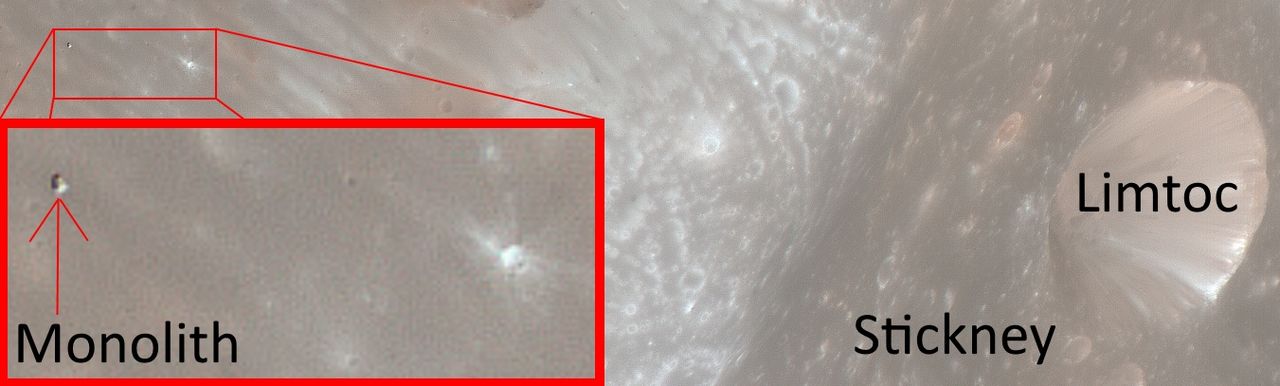
Monolith Closeup
The Colossal Monolith of Phobos
Phobos, the larger of Mars's two irregular moons, hosts a geological feature of extraordinary proportions: the Phobos monolith. This object is not merely a large boulder but a singular, massive geological formation, measuring an impressive 85 meters (279 feet) in diameter and 90 meters (300 feet) in height. Its dimensions are comparable to a substantial terrestrial building, making it a prominent and visually striking feature on the moon's surface.
The monolith's stark brightness contrasts with its surroundings, and the prominent shadow it casts underscores its significant topographic relief. Its classification as a monolith signifies its formation from a single, unbroken piece of rock, distinguishing it from fragmented debris fields. The discovery, initially made by Efrain Palermo through meticulous analysis of Martian probe imagery and subsequently verified by Lan Fleming, has positioned the monolith as a key object of scientific interest for planetary scientists and astronomers alike.
Hypothesizing Origins
The genesis of the Phobos monolith is a subject of intense scientific speculation, with the leading hypothesis suggesting it is impact ejecta originating from Mars. This theory posits that a cataclysmic asteroid impact on Mars could have ejected massive fragments of Martian crust into orbit. The Phobos monolith, being a substantial piece of rock, may represent one such fragment that was subsequently captured by Phobos's gravitational pull.
Its proximity to Stickney crater, Phobos's largest and most ancient impact feature, lends considerable weight to this hypothesis. Studying the monolith's composition could therefore provide direct, tangible evidence of Mars's geological past, offering a unique window into the planet's formation and early bombardment history. This makes it an invaluable target for understanding planetary evolution within the inner solar system.
Scientific Significance and the Drive for Exploration
The Phobos monolith holds considerable scientific significance, transcending its status as a mere geological curiosity. Its potential Martian origin makes it a prime candidate for sample return missions, which could revolutionize our understanding of Mars's composition and history without the need for direct Martian surface exploration. The proposed PRIME (Phobos Reconnaissance and International Mars Exploration) mission, a collaborative effort involving entities like Optech and the Mars Institute, was specifically designed with the monolith in mind.
This ambitious mission concept included both an orbiter and a lander, equipped with sophisticated instruments to conduct detailed geological and compositional analyses of Phobos, with a particular focus on the monolith. The continued advocacy for such missions, even by figures like former astronaut Buzz Aldrin, highlights the perceived scientific imperative to investigate this unique celestial artifact.
Observational History and Future Prospects
The initial visual evidence of the Phobos monolith emerged from images captured by the Mars Global Surveyor in 1998, specifically within image sets SP2-52603 and SP2-55103. These observations provided the first concrete data points for its existence and scale. It is crucial to differentiate this feature from a similarly named object on Mars itself, which NASA has characterized as a common geological formation indicative of regional surface processes.
The Phobos monolith, by contrast, is exceptional due to its singular nature and immense size. While the PRIME mission has not yet secured funding or a launch date, the scientific community's sustained interest in the monolith fuels ongoing discussions and planning for future exploratory endeavors. The potential for groundbreaking discoveries regarding planetary formation, impact dynamics, and the early solar system ensures that the Phobos monolith will remain a compelling target for decades to come.
See also
Based on content from Wikipedia · Licensed under CC BY-SA 4.0