

Parliament House, Canberra
Images

National Rose Garden, Old Parliament House, Canberra, Australia - circa 1960


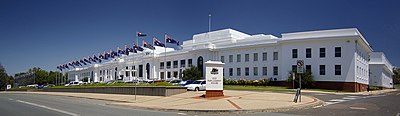


Geopolitical Placement and Urban Design
Parliament House occupies a prominent position atop Capital Hill, forming the apex of Canberra's National Triangle. This deliberate placement is not merely aesthetic; it is a profound statement of the centrality of federal governance within the nation's capital. The intersection of Commonwealth, Adelaide, Canberra, and Kings Avenues, all enclosed by State Circle, underscores its significance as a national nexus.
Canberra itself, a purpose-built capital, was conceived as a compromise and a symbol of unity. Parliament House, as the focal point of this carefully planned city, embodies the aspirations of a young nation establishing its identity and governmental infrastructure. The surrounding landscape and the building's integration into it are key elements of its design, intended to be both imposing and accessible.
Evolution of a National Symbol
The current Parliament House, officially opened on May 9, 1988, by Queen Elizabeth II, represents a significant evolution from its predecessor. The 'Old' Parliament House, operational from 1927, served the nation through critical periods of its history. However, as Australia grew and its parliamentary functions expanded, a larger and more modern facility became necessary.
The move 'up the hill' to the new building was more than a relocation; it signified a transition to a new era of governance, equipped with contemporary facilities to support the complex demands of a federal parliament and executive. The substantial cost of over $1.1 billion (equivalent to approximately $4.9 billion in 2022) reflects the ambition and scale of this national project.
The Nexus of Legislative and Executive Power
Parliament House is the physical embodiment of Australia's federal system, housing both the legislative and core executive branches of government. It is the meeting place for the Parliament of Australia, comprising the House of Representatives and the Senate, where laws are debated, amended, and enacted. Crucially, it also contains the essential infrastructure for the executive government, including the Cabinet room and the offices of the Prime Minister and federal ministers.
This close proximity facilitates the dynamic interplay between the government and the parliament, a fundamental aspect of Australia's Westminster system of government. The building's design actively supports these functions, fostering both deliberation and decisive action.
Architectural Vision and Construction Legacy
The design by Mitchell/Giurgola & Thorp Architects was selected through an international competition, aiming to create a building that was both functional and symbolically resonant. The construction, a monumental undertaking by Concrete Constructions and John Holland, involved complex engineering and a vast workforce. The building's design is notable for its integration with the landscape, featuring a distinctive roof that is often described as resembling two boomerangs or cupped hands, symbolizing the ceremonial meeting of the people and their government.
The use of Australian materials and the emphasis on public access, despite its governmental function, contribute to its status as an architectural icon and a symbol of national pride.
Civic Engagement and Educational Role
Beyond its governmental functions, Parliament House serves as a vital educational resource and a space for civic engagement. It is open to the public, allowing citizens to observe parliamentary proceedings, tour the building, and learn about Australia's democratic processes. This accessibility is a deliberate design choice, reinforcing the principle that government is of, by, and for the people.
Educational programs and visitor services are integral to the building's operation, aiming to foster a greater understanding of civics and the role of Parliament. The building itself, with its art collection and symbolic design elements, acts as a living museum, educating visitors about Australia's history, culture, and political landscape.
See also
Frequently Asked Questions
What is Parliament House in Canberra?+
Why is Parliament House on top of Capital Hill?+
When did the current Parliament House open?+
How big is Parliament House and how much did it cost?+
What can visitors do at Parliament House?+
Based on content from Wikipedia · Licensed under CC BY-SA 4.0