

Paris–Roubaix
Images

WVA Paris-Roubaix 2022




The Geographical Crucible
The Paris–Roubaix race unfolds across the landscape of northern France, a region characterized by its flat terrain and, crucially, its extensive network of historic cobblestone roads. The race route, which has evolved since its inception, now typically begins in Compiègne, approximately 85 kilometers northeast of Paris, and culminates in Roubaix, a city situated near the Belgian border. This geographical setting is fundamental to the race's identity.
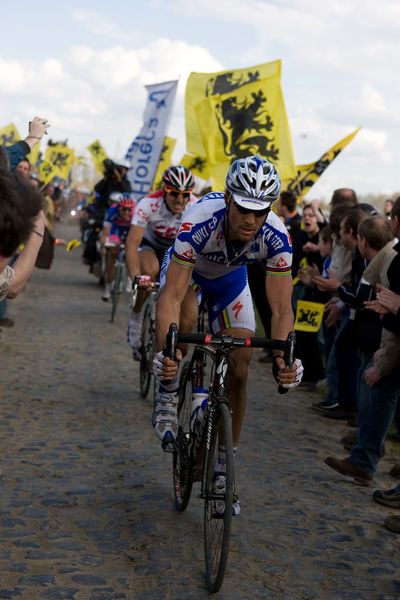
The 'pavé' – the French term for cobblestones, or setts – are not merely a feature but the defining element. These ancient, uneven stones, often laid centuries ago for horse-drawn carts, create a brutal and unpredictable surface for modern racing bicycles. The sheer length and severity of these pavé sectors, which can total over 50 kilometers across the entire course, transform the race into a grueling test of physical and mental fortitude.
The terrain demands specialized equipment and a unique riding style, as riders must constantly battle for position and control on a surface that actively tries to dislodge them. The proximity to Belgium also influences the race, as similar cobbled roads are common in Flemish cycling classics.
A Century of Suffering and Spectacle
Established in 1896, Paris–Roubaix stands as one of the oldest and most revered one-day professional cycling races globally. Its status as one of the 'Monuments' – a quintet of the most prestigious classic races – underscores its historical weight. The race's journey began with a start in Paris, but logistical changes saw it move to Chantilly in 1966 and then to Compiègne in 1977, reflecting the evolving demands of organizing such a massive event.
The finish has largely remained at the Roubaix Velodrome since 1943, providing a dramatic and fitting conclusion on a controlled track after the chaos of the pavé. The race has only been interrupted by major global events like the World Wars and, more recently, the COVID-19 pandemic, which caused postponements and cancellations, highlighting its deep-rooted tradition. The moniker 'Hell of the North,' popularized by the challenging conditions and the stark, often bleak, industrial landscape of the region, perfectly encapsulates the race's demanding nature and has become synonymous with its identity, even inspiring a film title.
The 'Cobbled Classics' and the Evolution of Cycling Technology
Paris–Roubaix is a cornerstone of the 'cobbled classics,' a sub-genre of cycling races characterized by their pavé sections, alongside events like the Tour of Flanders and E3 Harelbeke. The extreme nature of the course has driven significant innovation in bicycle technology. Manufacturers have developed specialized frames with enhanced vibration damping, stronger wheels designed to withstand constant impacts, and wider, lower-pressure tires that offer better grip and comfort on the rough surfaces.
Despite its prestige, the race is polarizing; some cyclists embrace the challenge, while others find the conditions too punishing and prone to luck-based outcomes due to mechanical failures. Punctures are a near-inevitable part of the race, often dictating the winner. The race has also seen its share of controversies, including disqualifications, which add to its dramatic narrative.
The winner's prize of a cobblestone, first awarded in 1977, is a tangible symbol of conquering this unique and brutal challenge.
Preserving the Legend
The enduring character of Paris–Roubaix is, in large part, thanks to the dedicated efforts of 'Les Amis de Paris–Roubaix' (The Friends of Paris–Roubaix). Formed in 1983, this group of passionate enthusiasts, often referred to as 'forçats du pavé' (convicts of the pavé), plays a vital role in maintaining the race's iconic cobblestone sectors. Their mission is to preserve the authenticity and difficulty of the pavé while ensuring a reasonable level of safety for the riders.
This involves meticulous work to keep the stones in place, clear debris, and manage the terrain without modernizing it to the point of losing its historic charm. Their commitment ensures that future generations of cyclists will continue to face the same legendary challenges that have defined Paris–Roubaix for over a century. The race's resilience, continuing year after year with only major global disruptions, speaks to its cultural significance and the deep affection it holds within the cycling world and among its dedicated custodians.
See also
Frequently Asked Questions
What is the Paris–Roubaix race?+
Why is it called the "Hell of the North"?+
Where does the race start and finish?+
What are pavé and why are they important?+
How do bikes need to be special for this race?+
Based on content from Wikipedia · Licensed under CC BY-SA 4.0