

OSIRIS-REx: A Space Rock Treasure Hunt!
Images

OSIRIS-REx Views the Earth During Flyby




A Mission Architected for Cosmic Origins
OSIRIS-REx (Origins, Spectral Interpretation, Resource Identification, Security-Regolith Explorer) was a flagship NASA mission under the New Frontiers Program, tasked with a singular, ambitious objective: to obtain samples from the near-Earth asteroid 101955 Bennu and return them to Earth for comprehensive scientific analysis. Launched on September 8, 2016, the mission targeted Bennu, a carbonaceous C-type asteroid, specifically chosen for its classification as a primitive body.
These asteroids are considered relics from the early Solar System, having undergone minimal geological alteration since their formation approximately 4.5 billion years ago. The scientific rationale behind selecting Bennu was its potential to harbor pristine carbonaceous material, including water-bearing minerals and organic molecules, which are fundamental to understanding the initial conditions of planetary formation and the potential delivery mechanisms of life's building blocks to early Earth.
The mission's design and execution were a testament to advanced engineering and meticulous scientific planning, aiming to unlock secrets held within this ancient celestial body.
Navigating the Asteroid Belt
Following its launch, OSIRIS-REx executed a complex trajectory, including a crucial Earth flyby on September 22, 2017, to gain the necessary velocity for its interplanetary journey. The spacecraft successfully rendezvoused with Bennu on December 3, 2018. The subsequent two years were dedicated to an intensive reconnaissance phase.
During this period, OSIRIS-REx mapped Bennu's surface in high resolution, analyzed its spectral properties, and identified potential sample collection sites. This phase was critical, as Bennu presented unexpected challenges, such as a rough, boulder-strewn surface and a surprisingly active environment with ejected particles. The mission team ultimately selected the 'Nightingale' site for sample collection.
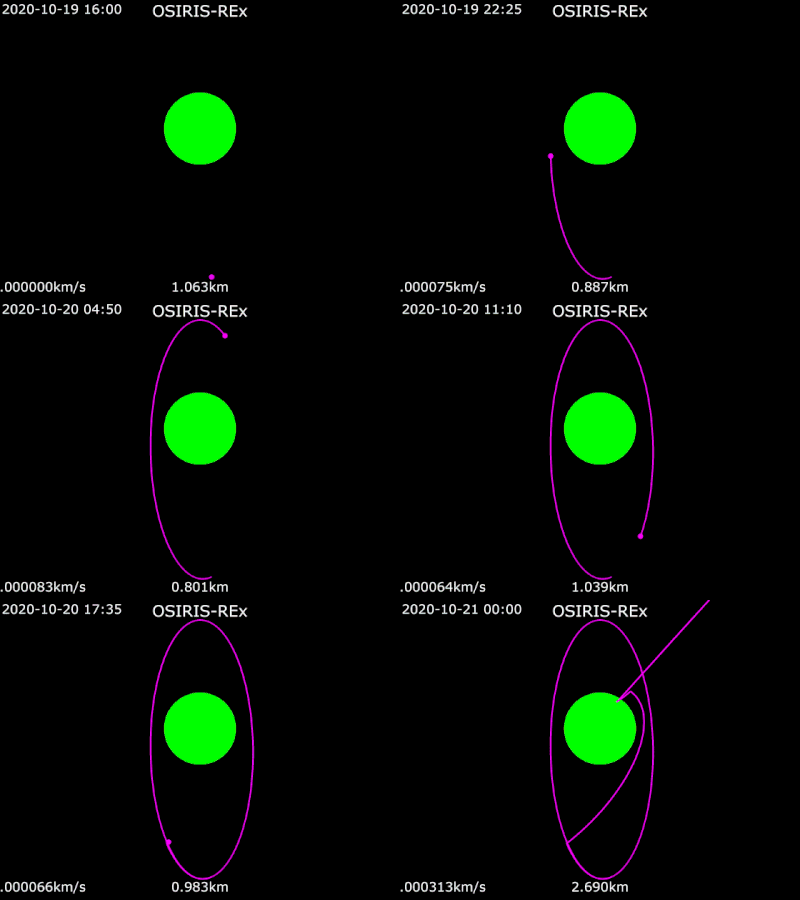
On October 20, 2020, the spacecraft executed the 'Touch-And-Go' (TAG) maneuver, descending to the surface and firing a thruster to stir up regolith, which was then collected by the sampler head. This delicate operation was a culmination of years of planning and simulation. OSIRIS-REx departed Bennu on May 10, 2021, initiating its return journey, which concluded with the successful deployment of the sample capsule to Earth on September 24, 2023.
Bennu's Primordial Significance
The scientific importance of the OSIRIS-REx mission cannot be overstated. Bennu, as a primitive carbonaceous asteroid, offers an unparalleled opportunity to study materials that predate the formation of the terrestrial planets. Its dark surface and composition are indicative of its ancient origins, providing direct evidence of the conditions present during the protoplanetary disk phase of our Solar System.
The presence of organic molecules, including amino acids, on Bennu is particularly significant. These molecules are the fundamental building blocks of proteins and are essential for life as we know it. Their discovery on asteroids and comets supports the theory of panspermia, which posits that life's ingredients could have been delivered to Earth from extraterrestrial sources.
By analyzing the returned samples, scientists can investigate the isotopic composition, mineralogy, and organic chemistry of Bennu, thereby shedding light on the processes of accretion, differentiation, and the potential for prebiotic chemistry in the early Solar System. This research directly addresses fundamental questions about our cosmic origins and the emergence of life.
A Legacy of Sample Return and Future Exploration
OSIRIS-REx marks a significant milestone as the first U.S. mission to successfully return asteroid samples to Earth, following in the footsteps of Japan's Hayabusa and Hayabusa2 missions. The returned samples are currently undergoing meticulous curation and analysis at NASA's Johnson Space Center and other designated facilities, promising to yield scientific publications and discoveries for decades. The mission's success has not only advanced our understanding of asteroids and early Solar System evolution but has also validated the complex technologies required for sample return missions.
Furthermore, the OSIRIS-REx spacecraft itself has been repurposed for an extended mission, now designated OSIRIS-APEX. It is en route to study asteroid 99942 Apophis, a potentially hazardous near-Earth asteroid, with an expected flyby in April 2029. This extended mission allows for further exploration and data collection, leveraging the spacecraft's capabilities to investigate another scientifically compelling target and contributing to our ongoing efforts to understand and characterize the asteroid population.
See also
Based on content from Wikipedia · Licensed under CC BY-SA 4.0