

Orbital Decay: When Space Stuff Falls Down!
Images

Orbital decay


The Physics of Orbital Degradation
Orbital decay is the process by which an object in orbit gradually loses altitude. The primary mechanism for objects in low Earth orbit (LEO) is atmospheric drag. Even at altitudes of several hundred kilometers, a tenuous atmosphere exists.
Satellites passing through this exosphere encounter gas molecules and ions, experiencing a resistive force that opposes their motion. This drag is highly dependent on factors like atmospheric density (which varies with solar activity), the satellite's velocity, and its shape and surface area. As the satellite loses kinetic energy due to drag, its orbital velocity decreases, allowing Earth's gravitational pull to draw it into a lower, faster orbit.
This cycle continues, leading to a spiral descent. Other contributing factors, though less significant in LEO, include tidal forces, radiation pressure, and gravitational perturbations from the Sun and Moon.
Tracking and Mitigation
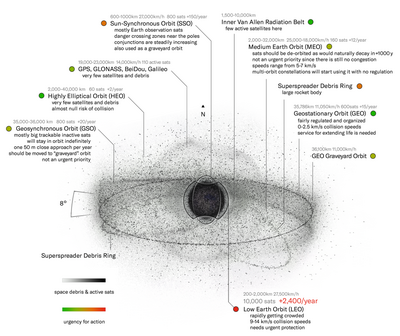
The increasing amount of space debris in Earth's orbit presents a significant challenge, exacerbated by orbital decay. Defunct satellites, spent rocket stages, and fragments from collisions all contribute to this hazard. As these objects decay, their re-entry trajectories must be precisely predicted to avoid potential ground impact.
While most smaller debris burns up completely in the atmosphere, larger pieces can survive. Space agencies employ sophisticated tracking systems to monitor thousands of objects. Mitigation strategies include controlled de-orbiting of satellites at the end of their mission, using propulsion systems to guide them into a safe atmospheric burn-up, or employing technologies like drag sails to accelerate decay.
International guidelines aim to minimize the creation of new debris and ensure the long-term sustainability of space activities.
Beyond Earth
Orbital decay is not exclusive to Earth's orbit. It plays a crucial role in the evolution of planetary systems. For instance, the process of tidal locking, where a celestial body's rotation period matches its orbital period (like the Moon with Earth), is a result of tidal forces that cause orbital decay and synchronization over eons.
In binary star systems, gravitational interactions and mass transfer can lead to orbital decay, potentially causing stars to merge or undergo dramatic evolutionary changes. The detection of exoplanets has revealed numerous systems where orbital decay is a factor, influencing planetary migration and the ultimate fate of planets within their stellar systems. Understanding these processes is vital for comprehending planetary formation and the potential for life elsewhere.
The Moon's Receding Orbit
The Moon's gradual recession from Earth is a fascinating example of orbital mechanics driven by tidal forces. Earth's rotation is slightly faster than the Moon's orbital period. This differential speed causes Earth's tidal bulges to lead the Moon slightly.
The gravitational pull of these bulges on the Moon exerts a torque, transferring angular momentum from Earth's rotation to the Moon's orbit. This transfer causes Earth's rotation to slow down (lengthening our day) and the Moon's orbit to expand, increasing its distance from Earth by approximately 3.8 centimeters per year. This process is a slow but continuous evolution of the Earth-Moon system, demonstrating how gravitational interactions shape celestial dynamics over geological timescales.
See also
Frequently Asked Questions
What is orbital decay?+
How does atmospheric drag make satellites fall?+
Why does the Moon get farther from Earth?+
What happens to space debris when it decays?+
How do space agencies help satellites fall safely?+
Based on content from Wikipedia · Licensed under CC BY-SA 4.0