

Orange Free State
Images

Locator map of Orange Free State Province as of 1 March 1994


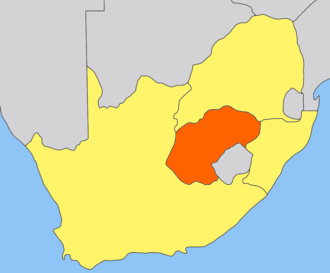
The Genesis of a Sovereign Boer State
The Orange Free State (Oranje Vrijstaat) emerged in the mid-19th century as a distinct political entity in Southern Africa, representing a significant chapter in the history of Boer self-determination. Established on February 23, 1854, through the Orange River Convention, this landlocked republic was geographically defined by the confluence of the Orange and Vaal rivers. Its foundation was rooted in the Great Trek and the subsequent desire of Boer settlers, primarily of Dutch, German, and French Huguenot descent, to escape British colonial administration and establish a society that reflected their cultural and religious values.
The territory had previously been under British influence as the Orange River Sovereignty, proclaimed in 1848 with a British Resident based in Bloemfontein. However, the British Crown eventually relinquished its administrative and defensive responsibilities, paving the way for the recognition of the Orange Free State's independence. This act was a crucial moment, allowing the Boers to govern themselves, though it also set the stage for future conflicts with neighboring colonial powers and indigenous populations.
Identity, Governance, and External Relations
The Orange Free State developed a unique identity, distinct from its neighbor, the South African Republic (Transvaal). While both were Boer republics, the Orange Free State often maintained a more pragmatic and less expansionist foreign policy, at least initially. Its official language was Dutch, a testament to its European heritage, and its governance structure was republican, emphasizing elected leadership.
The country's economy was largely agrarian, centered around farming and ranching. However, its existence was constantly influenced by its powerful neighbors, particularly the British Empire, which controlled the Cape Colony. The discovery of diamonds in the region in the late 1860s significantly altered the geopolitical landscape, increasing British interest and leading to territorial disputes, although the Orange Free State managed to retain its independence for a time.
This period highlights the complex interplay of settler ambitions, resource discovery, and imperial ambitions in shaping the political map of Southern Africa.
The Shadow of Imperialism and the Second Boer War
The Orange Free State's independence, while cherished, was ultimately unsustainable in the face of growing British imperial power and economic interests, particularly after the discovery of diamonds and later gold. The relationship between the Orange Free State and the British Empire became increasingly strained, culminating in the Second Boer War (1899-1902). Initially, the Orange Free State allied with the South African Republic (Transvaal) against the British.
The war was a brutal and devastating conflict for the Boer republics. Despite fierce resistance, the superior resources and manpower of the British Empire eventually led to their victory. In 1900, the Orange Free State was annexed by Britain and renamed the Orange River Colony.
The republic officially ceased to exist as an independent entity on May 31, 1902, with the signing of the Treaty of Vereeniging, which marked the end of the war and the subjugation of the Boer republics.
From Colony to Province
Following its annexation, the Orange River Colony was under direct British rule. However, the seeds of future self-governance were sown, leading to the granting of responsible government in 1907. A pivotal moment in South African history occurred in 1910 with the formation of the Union of South Africa, a self-governing dominion within the British Empire.
The Orange Free State, along with the Cape Province, Natal, and the Transvaal, became one of the four founding provinces of the Union. This marked the end of its existence as a separate political entity but ensured its continued presence within a larger South African framework. In 1961, the Union of South Africa became the Republic of South Africa.
Today, the territory of the former Orange Free State is known as the Free State province, a direct descendant of this historical republic, carrying its legacy within the modern nation of South Africa. Its story is a vital component in understanding the complex historical forces that shaped contemporary South Africa.
Go deeper
Frequently Asked Questions
What was the Orange Free State?+
When did the Orange Free State become independent?+
Why did the Boers want to create the Orange Free State?+
How did the Orange Free State end?+
What was the main job of the Orange Free State's economy?+
Based on content from Wikipedia · Licensed under CC BY-SA 4.0