

Opportunity (rover)
Images

Mars Opportunity Rover Replica Launch with Dr Vandi Verma at St Kentigern School, Auckland, 16 September 2024-14




Genesis of a Martian Pioneer
The Mars Exploration Rover (MER) program, a cornerstone of NASA's robotic exploration strategy, aimed to deploy two highly mobile, solar-powered rovers to Mars to search for and analyze a wide range of rocks and soils that may hold clues to past water activity. Opportunity, designated MER-B, was the second of these twin rovers, launched on July 7, 2003. Its design prioritized durability and scientific capability, featuring a sophisticated suite of instruments including panoramic and microscopic cameras, spectrometers (Mössbauer and Alpha Particle X-ray Spectrometer), and a rock abrasion tool.
The landing site, Meridiani Planum, was chosen for its potential to reveal layered sedimentary rocks, indicative of past aqueous processes. The mission's initial objective was a modest 90 Martian sols (approximately 92.5 Earth days), a conservative estimate given the harsh Martian environment.
Engineering for Endurance
Opportunity's operational lifespan became its most defining characteristic, far surpassing initial projections. It functioned for an unprecedented 5111 Martian sols, equivalent to over 14 Earth years, a duration 57 times its planned mission. This extraordinary longevity was a triumph of engineering and operational strategy.
The rover's reliance on solar power necessitated meticulous energy management. Opportunity's batteries were continually recharged by its solar arrays, but Martian dust storms posed a significant threat. The rover's ability to enter a low-power 'hibernation' mode during these events was crucial for survival, allowing it to conserve energy until sufficient sunlight returned.
This adaptive strategy, coupled with the rover's inherent robustness, enabled it to withstand numerous environmental challenges, including extreme temperatures and abrasive dust.
A Grand Traverse
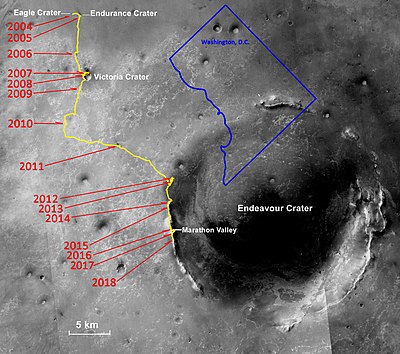
Over its extended mission, Opportunity covered an astonishing 45.16 kilometers (28.06 miles) of Martian terrain, setting a record for extraterrestrial vehicle mileage. This extensive traverse allowed for in-depth geological investigations across diverse landscapes. Key mission highlights included the discovery of 'Heat Shield Rock,' the first meteorite found on another planet, and over two years dedicated to exploring the immense Victoria Crater.
The rover meticulously navigated the crater's complex geology, providing detailed insights into its formation and history. Later, Opportunity reached the rim of Endeavour Crater, a site of immense scientific interest due to its ancient geological strata, which offered a unique window into Mars' early history and potential for past habitability.
The Dust Storm and the Enduring Legacy
The mission's conclusion came in 2018 with a planet-encircling dust storm that drastically reduced solar irradiance across Mars. Opportunity lost communication with Earth on June 10, 2018, and entered its final hibernation phase. Despite NASA's persistent efforts to re-establish contact, including anticipating favorable weather patterns that might clear its solar panels, the rover remained unresponsive.
On February 13, 2019, the mission was officially declared complete. Opportunity's legacy transcends its operational end; it provided irrefutable evidence of Mars' past watery environments, significantly advancing our understanding of planetary evolution and the conditions necessary for life. Its success has profoundly influenced the design and objectives of subsequent Mars missions, solidifying its place as one of NASA's most successful and inspiring ventures.
See also
Frequently Asked Questions
What was the Opportunity rover and how long did it last on Mars?+
Why did Opportunity use solar power and how did it survive dust storms?+
Where did Opportunity land and why was that place chosen?+
What were some of the big discoveries Opportunity made?+
How far did Opportunity travel on Mars?+
Based on content from Wikipedia · Licensed under CC BY-SA 4.0