

Ojos del Salado
Images

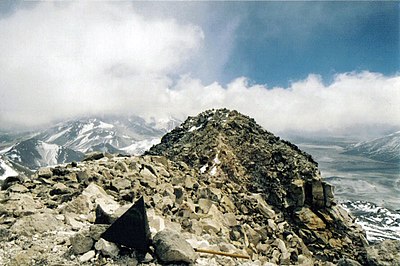
Ojos del Salado descent - view towards the fixed ropes


Geological Grandeur and Volcanic Architecture
Ojos del Salado, situated in the Puna de Atacama region of the Andes, is a stratovolcanic complex of immense scale, recognized as the highest volcano on Earth. Its summit reaches an imposing 6,893 meters (22,615 feet) above sea level, making it the highest point in Chile and a significant landmark on the Argentina-Chile border. The volcano's structure is not monolithic but rather a composite of several overlapping lava domes, extensive lava flows, and multiple volcanic craters.
This complex morphology covers an area estimated between 70 and 160 square kilometers, indicative of its extensive eruptive history. The upper reaches are characterized by sparse ice cover, a testament to the extreme environmental conditions that prevail at such altitudes. The sheer scale and intricate construction of Ojos del Salado highlight its long and dynamic geological evolution, shaped by numerous eruptive phases over millennia.
The Paradox of Aridity and Extreme Hydrology
The mountain's location near the Arid Diagonal of South America dictates its exceptionally dry climate. This extreme aridity is the primary reason for the absence of substantial glaciers and permanent snow cover, features typically associated with high-altitude mountains. Despite these desiccating conditions, Ojos del Salado hosts a remarkable hydrological feature: a permanent crater lake.
Located within the summit crater, east of the main peak, this lake sits at an astonishing elevation of 6,480 to 6,500 meters (21,260 to 21,300 feet). With a diameter of approximately 100 meters, it is recognized as the highest lake of any kind globally. The existence of liquid water at such extreme altitudes, coupled with the barren, vegetation-less slopes, presents a unique case study in high-altitude geomorphology and the resilience of certain natural phenomena in hostile environments.
Chronology of Eruptive Activity and Tectonic Influences
Ojos del Salado's volcanic activity spans the Pleistocene and Holocene epochs, periods marked by significant geological change. Its eruptive history is primarily characterized by the extrusion of lava flows, which contributed to the building of its complex structure. The volcano's development involved at least two distinct phases of activity, during which a significant depression or caldera was formed.
Furthermore, the geological narrative of Ojos del Salado is intertwined with the activity of its neighbors, notably Nevado Tres Cruces to the west, which has influenced its geological evolution. The last confirmed major eruption occurred around 750 CE. However, more recent observations in November 1993 of steam emissions suggest potential ongoing, albeit minor, volcanic activity, prompting continued monitoring of this colossal dormant volcano.
Human Exploration and Geographical Significance
The accessibility of Ojos del Salado has facilitated human exploration and scientific study. An international highway traverses the region north of the mountain, providing a crucial link between Argentina and Chile and enabling access for expeditions. The first documented ascent of Ojos del Salado was achieved in 1937 by members of a Polish expedition, Jan Alfred Szczepański and Justyn Wojsznis, marking a significant milestone in mountaineering history.
For a period in the mid-20th century, Ojos del Salado was a subject of geographical debate, with discussions centering on whether it or Aconcagua held the title of the highest peak in South America. This debate was ultimately resolved in favor of Aconcagua, but Ojos del Salado retains its distinction as the world's highest volcano, a testament to its unique geological status and the extreme environments it represents.
See also
Based on content from Wikipedia · Licensed under CC BY-SA 4.0