

Nuclear Fission: Splitting Atoms for Power!
Images
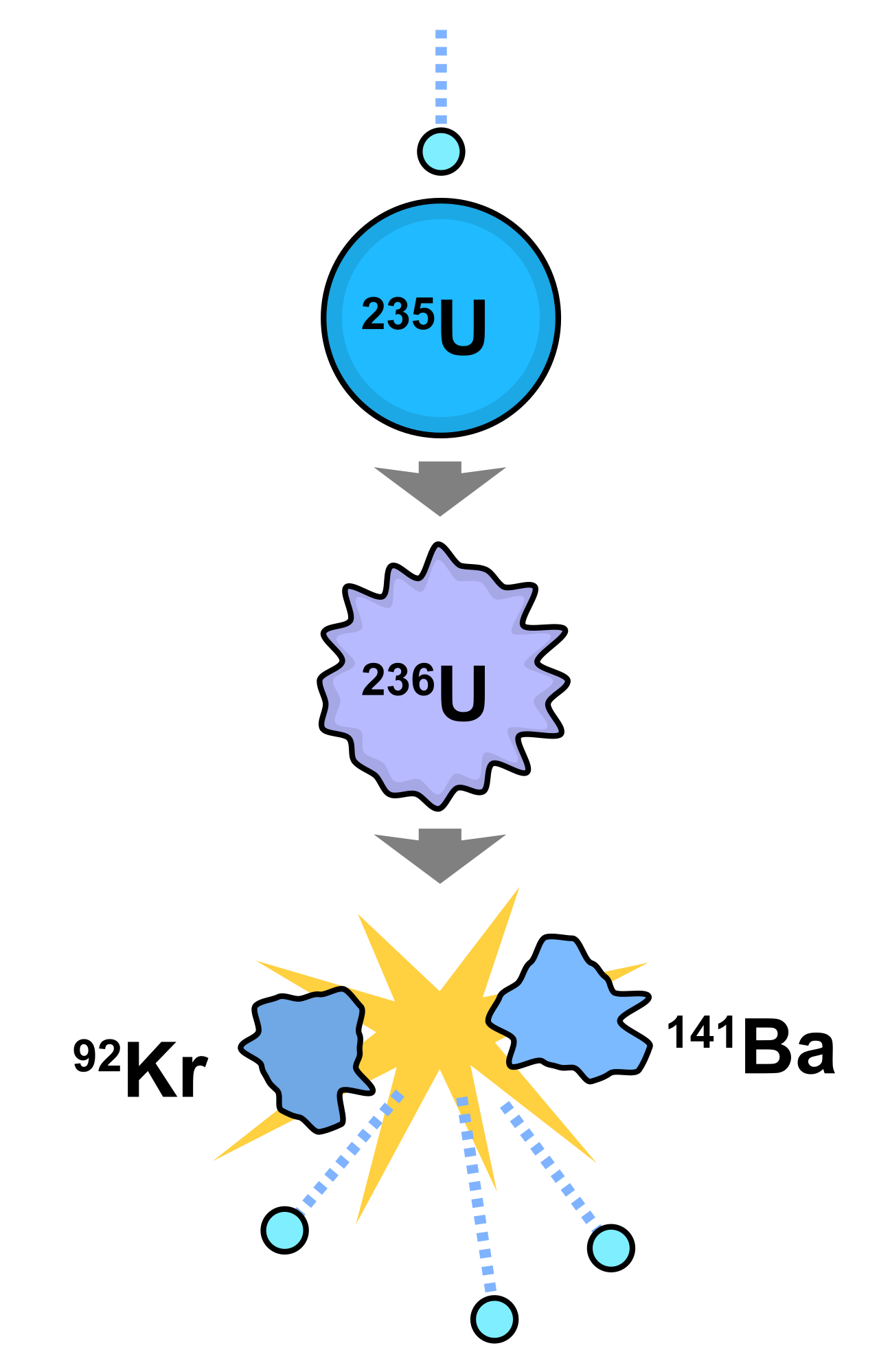
Nuclear fission


Deconstructing the Nucleus
Nuclear fission is a nuclear reaction in which the nucleus of an atom splits into two or more smaller, lighter nuclei. This process typically occurs with heavy, unstable isotopes, most notably Uranium-235 (U-235) and Plutonium-239 (Pu-239). The fission event is initiated when a neutron strikes the nucleus of a fissile atom.
The nucleus absorbs the neutron, becoming highly unstable and deforming. This deformation leads to the nucleus splitting, often into two daughter nuclei (fission fragments) of roughly half the original mass, along with the release of several high-energy neutrons (typically 2-3) and a significant amount of energy. This energy is released primarily as kinetic energy of the fission fragments and neutrons, as well as gamma radiation.
The binding energy per nucleon is greater for the daughter nuclei than for the original heavy nucleus, which is why energy is released according to Einstein's famous equation, E=mc².
Discovery and Early Research
The discovery of nuclear fission in late 1938 by Otto Hahn and Fritz Strassmann, with crucial theoretical interpretation by Lise Meitner and Otto Frisch, marked the beginning of the atomic age. Working in Berlin, Hahn and Strassmann observed that bombarding uranium with neutrons produced barium, an element far lighter than uranium. Meitner, who had fled to Sweden, and her nephew Frisch, visiting from Denmark, recognized that the uranium nucleus had split.
Frisch coined the term 'fission,' drawing an analogy to cell division in biology. This discovery quickly led to intense research worldwide, driven by the realization of the immense energy potential and the possibility of a self-sustaining chain reaction. The subsequent Manhattan Project during World War II was a monumental effort to harness this energy for military purposes, culminating in the development of the first atomic bombs.
The Chain Reaction
The critical concept underpinning nuclear energy is the chain reaction. The neutrons released during fission can go on to induce fission in other fissile nuclei. For a chain reaction to be sustained, on average, at least one neutron from each fission event must cause another fission.
This requires a sufficient quantity of fissile material, known as the critical mass, and appropriate geometry. In nuclear reactors, this chain reaction is meticulously controlled. Control rods, often made of neutron-absorbing materials like cadmium or boron, are inserted or withdrawn to regulate the neutron population and thus the rate of fission.
Moderators, such as water or graphite, are used to slow down the fast neutrons released during fission, making them more likely to cause further fission in U-235. This controlled release of energy is what allows nuclear reactors to generate electricity safely and continuously.
Global Impact
Nuclear fission has had a profound and multifaceted impact on the world. Its most prominent application is in nuclear power generation, providing a significant source of baseload electricity with a low carbon footprint, crucial for combating climate change. However, concerns about nuclear waste disposal and the potential for accidents (like Chernobyl and Fukushima) remain significant challenges.
Beyond power, fission is vital in nuclear medicine, where radioisotopes produced in reactors are used for diagnostic imaging (e.g., PET scans) and therapeutic treatments for cancer. The proliferation of nuclear weapons, a direct consequence of fission research, has shaped international relations and security policies for decades, leading to treaties and ongoing efforts for non-proliferation. The dual-use nature of nuclear technology necessitates careful international oversight and ethical consideration.
Go deeper
Frequently Asked Questions
What is nuclear fission?+
How does a chain reaction happen in a nuclear reactor?+
Who discovered nuclear fission and when?+
Why is nuclear fission useful for making electricity?+
What are some safety concerns about nuclear fission?+
Based on content from Wikipedia · Licensed under CC BY-SA 4.0