

Nondisjunction: When Cells Get Mixed Up!
Images
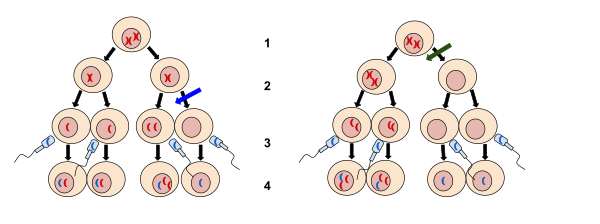
Nondisjunction


The Spindle Apparatus and the Mechanics of Segregation Failure
Nondisjunction, the failure of chromosomes or chromatids to segregate properly during cell division, is a critical event with far-reaching consequences. This error primarily stems from malfunctions in the spindle apparatus, the dynamic microtubule structure responsible for separating chromosomes. During meiosis I, nondisjunction occurs when homologous chromosomes fail to align correctly at the metaphase plate or when the cohesion that holds them together is prematurely degraded, leading to their premature separation.
In meiosis II and mitosis, nondisjunction involves the failure of sister chromatids to separate, often due to issues with kinetochore-microtubule attachments or the timely activation of the anaphase-promoting complex/cyclosome (APC/C). The precise timing and coordination of these events are paramount; even minor disruptions can result in aneuploid gametes or somatic cells. Understanding these molecular mechanisms is crucial for comprehending the etiology of various genetic disorders.
Historical Context
The discovery of nondisjunction in the early 20th century was a pivotal moment in genetics. Calvin Bridges, working in Thomas Hunt Morgan's lab at Columbia University in 1910, meticulously studied sex-linked traits in Drosophila melanogaster. His observations of unusual inheritance patterns, particularly in sex chromosomes, led him to propose the concept of nondisjunction.
He noted that when chromosomes failed to segregate properly, it resulted in offspring with unexpected combinations of traits, such as male flies with XX chromosomes or female flies with XY chromosomes. This empirical evidence provided robust support for the nascent chromosome theory of heredity, which posited that chromosomes are the physical carriers of genetic information. Bridges' work was instrumental in solidifying this foundational principle of modern biology.
The Genetic and Clinical Ramifications
The most significant consequence of nondisjunction is the generation of aneuploid cells, which possess an abnormal number of chromosomes. In humans, aneuploidy in germ cells can lead to conditions such as Down syndrome (trisomy 21), Edwards syndrome (trisomy 18), and Patau syndrome (trisomy 13), each characterized by distinct developmental abnormalities. Nondisjunction in somatic cells, while often leading to cell death or being corrected, can also contribute to the development of cancer by promoting genomic instability and the acquisition of oncogenic mutations.
The severity of aneuploidy's impact depends on the specific chromosome involved and whether it is a gain or loss of genetic material. Research into the causes and consequences of aneuploidy continues to drive advancements in genetic diagnostics and therapeutic strategies.
Mitotic vs. Meiotic Nondisjunction
While both meiosis and mitosis are susceptible to nondisjunction, the implications differ significantly. Meiotic nondisjunction directly impacts gamete formation, leading to the potential for aneuploid offspring. Factors influencing meiotic nondisjunction include maternal age, which is strongly correlated with an increased risk of nondisjunction events in oocytes, and potentially environmental factors.
Mitotic nondisjunction, occurring during the division of somatic cells, can result in mosaicism, where an individual has populations of cells with different chromosomal complements. This can occur during embryonic development or later in life. While often less immediately apparent than meiotic nondisjunction, mitotic nondisjunction can play a role in developmental disorders and the progression of certain cancers, highlighting its importance across different biological contexts.
See also
Based on content from Wikipedia · Licensed under CC BY-SA 4.0