

NGC 5962
Images

NGC 5962
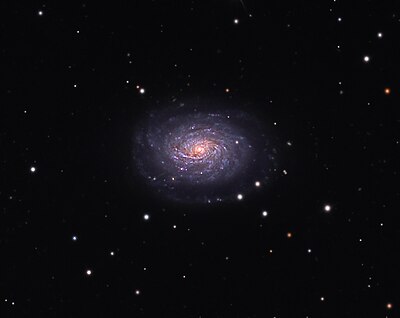

Morphology and Dynamics of NGC 5962
NGC 5962 is classified as a barred spiral galaxy (SBc), a designation that highlights its prominent central bar structure from which its spiral arms emanate. This bar is not merely a visual feature; it plays a crucial dynamical role in redistributing angular momentum within the galaxy and channeling gas towards the central region. The 'c' classification indicates that its spiral arms are relatively loosely wound, suggesting a moderate rate of star formation compared to more tightly wound spirals.
The galaxy's disk is composed of stars, gas, and dust, with the spiral arms being active sites of ongoing star formation, evidenced by the presence of young, hot, blue stars and H II regions. The central bulge, while less prominent than in some other barred spirals, still contains a significant population of older, redder stars. Understanding the interplay between the bar, the spiral arms, and the central bulge is key to comprehending the galaxy's overall evolution and stability.
The dynamics within NGC 5962 are influenced by the gravitational pull of its constituent stars, gas, dust, and likely a central supermassive black hole, creating complex orbital patterns and gas flows.
Historical Context
The initial discovery of NGC 5962 by Lewis Swift on March 1, 1885, was part of a broader astronomical effort to catalog and understand the nature of nebulae. In the late 19th century, the distinction between nebulae within our own Milky Way and distant, independent galaxies was still a subject of intense debate. Swift's observation, recorded in the New General Catalogue (NGC) of Deep Sky Objects, contributed to the growing body of evidence that suggested the existence of extragalactic nebulae.
Subsequent observations with increasingly powerful telescopes allowed astronomers to resolve these objects into individual stars, confirming their galactic nature. The classification of NGC 5962 as a barred spiral galaxy evolved over time as observational techniques improved and theoretical models of galactic structure were developed. Its inclusion in various astronomical surveys has made it a well-studied object, providing valuable data points for understanding the distribution and types of galaxies in the universe.
Cosmological Significance
NGC 5962 holds significant value for cosmologists studying the formation and evolution of galaxies. As a barred spiral, it serves as a representative example for understanding the prevalence and impact of bars on galactic structure and evolution. Bars are thought to be common, potentially influencing star formation rates, the distribution of gas, and the growth of central supermassive black holes.
The study of NGC 5962 allows researchers to test models of bar formation and dissolution, as well as the secular evolution of galaxies over cosmic timescales. Furthermore, its location within the Leo Cluster provides opportunities to study environmental influences on galaxy evolution, such as interactions with other galaxies and the effects of the cluster's intracluster medium. By analyzing the stellar populations, gas content, and kinematics of NGC 5962, astronomers can gain insights into the processes that shape galaxies like our own Milky Way, contributing to a more comprehensive understanding of the universe's structure and history.
Stellar Populations and Activity within NGC 5962
The stellar content of NGC 5962 is diverse, reflecting its ongoing evolutionary processes. The spiral arms are characterized by regions of active star formation, where molecular clouds collapse under gravity to form new generations of stars. These young stars are typically hot, luminous, and blue, often found in clusters.
The presence of H II regions, glowing clouds of ionized hydrogen, further indicates active star birth. In contrast, the galactic bulge and halo are dominated by older, cooler, redder stars, representing the remnants of earlier star formation epochs. The central bar is also thought to be a site of significant stellar activity, potentially influencing the star formation rate in its vicinity.
While direct observation of the supermassive black hole at its center is challenging, its gravitational influence is inferred from the dynamics of stars and gas in the galactic core. Studying the distribution and properties of these stellar populations helps astronomers reconstruct the galaxy's past star formation history and predict its future evolution.
NGC 5962 in the Broader Cosmic Landscape
NGC 5962 is not an isolated entity but part of a larger cosmic tapestry. Its distance of approximately 110 million light-years places it within the realm of relatively nearby galaxies, making it an accessible target for detailed study. As a member of the Leo Cluster, it exists in a dynamic environment where gravitational interactions with other galaxies can influence its structure and evolution.
These interactions can trigger bursts of star formation, distort galactic shapes, and even lead to galaxy mergers over billions of years. The study of galaxy clusters like Leo provides crucial data for understanding large-scale structure formation in the universe and the role of environment in shaping individual galaxies. By comparing NGC 5962 with galaxies in different environments, astronomers can better understand the universal principles governing galactic evolution and the diversity of cosmic structures we observe.
See also
Frequently Asked Questions
What is NGC 5962?+
Why does NGC 5962 have a bar?+
How do scientists study NGC 5962?+
When was NGC 5962 discovered?+
Where is NGC 5962 located?+
Based on content from Wikipedia · Licensed under CC BY-SA 4.0