

NGC 3310
Images
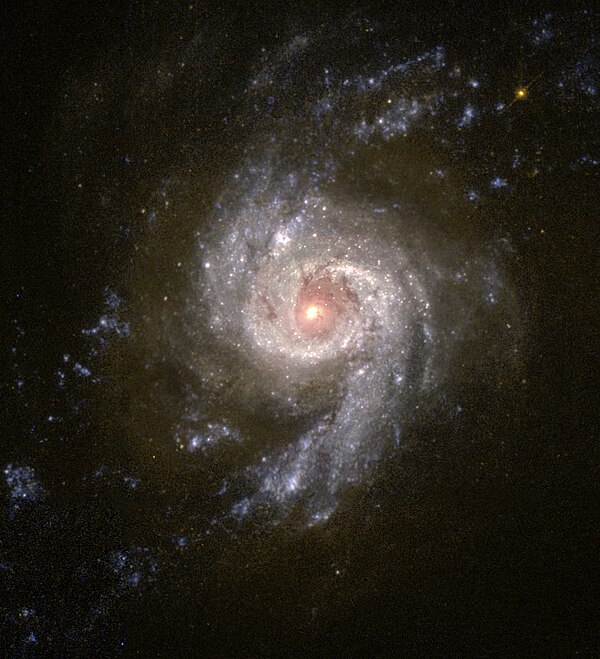
NGC 3310


The Dynamics of a Hyperactive Spiral
NGC 3310 stands as a prime example of a spiral galaxy undergoing a vigorous starburst phase, characterized by an exceptionally high rate of stellar birth. This phenomenon is not uniformly distributed but is predominantly concentrated within a distinct circumnuclear starburst ring, a structure that encircles the galaxy's central bulge. The star formation rate here is orders of magnitude greater than in typical spiral galaxies, suggesting a powerful external or internal trigger.
This intense activity means that NGC 3310 is rapidly consuming its reservoir of molecular gas, the raw material for star formation. Astronomers study such galaxies to understand the physical conditions that drive these extreme events, including the role of gas dynamics, feedback from massive stars, and the influence of the central supermassive black hole. The study of NGC 3310's starburst ring provides a unique laboratory for observing stellar populations in their earliest stages of evolution and for probing the complex interplay of forces within a galaxy's core.
Gravitational Scars
The prevailing theory for the origin of NGC 3310's starburst activity points to a significant past galactic merger. Evidence suggests that NGC 3310 experienced a collision and subsequent accretion of a smaller companion galaxy. Such interactions are known to be potent triggers for starbursts. The gravitational disruption caused by the merger would have funneled large quantities of gas and dust towards the galactic center, compressing these materials and initiating widespread star formation.
This process is not instantaneous; it involves complex gravitational dynamics over millions of years, reshaping the galaxies involved. The resulting starburst is often characterized by the formation of massive, hot stars that dominate the galaxy's luminosity in the short term. Analyzing the morphology, kinematics, and stellar populations of NGC 3310 allows astronomers to reconstruct the history of this merger and its lasting impact on the galaxy's evolution, providing a tangible example of how galaxy mergers drive cosmic evolution.
A Cosmic Laboratory
NGC 3310 holds considerable importance for astrophysical research, serving as a crucial testbed for theories of galaxy formation and evolution. Its high star formation rate allows for the study of stellar populations and their chemical enrichment in an accelerated manner. By observing the diverse range of stars, from massive O and B stars to lower-mass stars, astronomers can gain insights into initial mass functions and stellar evolution pathways under extreme conditions.
Furthermore, the presence of a prominent starburst ring provides a unique opportunity to study the feedback mechanisms between newly formed stars and their surrounding interstellar medium, including supernova explosions and stellar winds. Understanding these processes in NGC 3310 helps refine models of how galaxies grow and evolve over cosmic time, particularly in the context of early universe conditions where mergers and starbursts were more prevalent. It also offers clues about the potential future evolution of our own Milky Way galaxy.
The Circumnuclear Starburst Ring
The circumnuclear starburst ring in NGC 3310 is the focal point of its intense stellar activity. This ring is a dense, gaseous structure that orbits the galactic nucleus, likely influenced by the supermassive black hole at its center and the residual effects of the past merger. The high density of molecular gas within this ring provides the necessary conditions for gravitational collapse and rapid star formation.
The ring is a dynamic environment, characterized by ongoing bursts of star formation, the presence of massive young stellar clusters, and significant outflows of gas driven by supernovae and stellar winds. Studying the spectral properties and spatial distribution of stars within this ring allows astronomers to determine the age, metallicity, and star formation history of this region. The ring's existence and activity are critical for understanding how galaxies build up their stellar mass and how central regions evolve under the influence of both gas accretion and feedback processes.
Broader Implications and Future Research
The study of NGC 3310 extends beyond its immediate characteristics, offering broader implications for our understanding of the universe. Its merger history and subsequent starburst provide a tangible example of how galaxy interactions shape the cosmic landscape. Future research could involve more detailed observations with advanced telescopes, such as the James Webb Space Telescope, to probe the earliest stages of star formation within the ring and to analyze the chemical composition of the gas and newly formed stars with unprecedented precision.
Investigating potential outflows and their impact on the surrounding intergalactic medium is also crucial. Furthermore, comparing NGC 3310 with other starburst galaxies can help establish universal principles governing merger-induced star formation and the evolution of galactic nuclei. Understanding such extreme galactic phenomena is fundamental to piecing together the grand narrative of cosmic structure formation.
See also
Based on content from Wikipedia · Licensed under CC BY-SA 4.0