

NGC 1999
Images
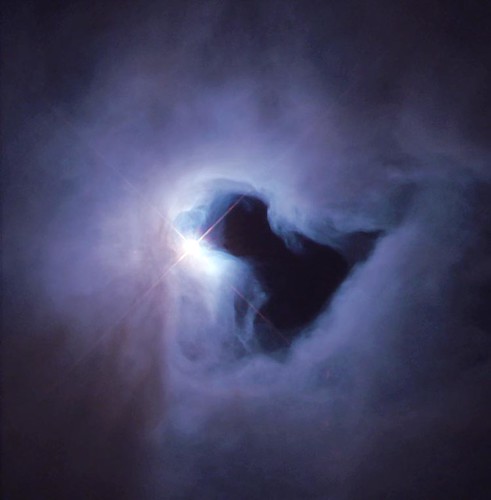
Reflection Nebula NGC 1999


NGC 1999
NGC 1999, also known as the Cosmic Keyhole, is a prominent reflection nebula situated approximately 1,500 light-years away in the constellation Orion. Its visual appearance is dominated by a bright, nebulous cloud that scatters the light from its central illuminating source, the variable star V380 Orionis. Reflection nebulae are characterized by their emission of light that is scattered by dust particles, rather than direct emission from ionized gas, which is typical of emission nebulae.
The distinctive 'keyhole' shape is partly due to the presence of a significant dark patch, which was initially misinterpreted, leading to a deeper investigation into the complex astrophysical processes at play within this star-forming region.
The Genesis of the Dark Patch Enigma
The striking dark feature within NGC 1999 was, for a considerable period, classified as a dark nebula-a dense, opaque cloud of interstellar dust and gas that effectively obscures background light. This interpretation was consistent with observations from ground-based optical telescopes. However, the advent of advanced infrared observatories provided the capability to penetrate such dusty environments.
The Herschel Space Observatory's observations in 2009 were pivotal. Its infrared instruments, designed to detect radiation that can pass through dense dust, revealed that the patch remained dark. This unexpected finding challenged the prevailing hypothesis, suggesting either an unprecedented density of obscuring material or a phenomenon not readily explained by standard models of interstellar clouds.
The Void of NGC 1999
Further observational campaigns, employing radio telescopes like the Atacama Pathfinder Experiment and optical/submillimeter instruments such as the Mayall and Magellan telescopes, were instrumental in resolving the mystery. These multi-wavelength observations conclusively demonstrated that the dark patch is not a dense concentration of dust and gas, but rather a region of near-vacuum. The prevailing scientific hypothesis posits that this void was created by energetic outflows.
Specifically, narrow jets of gas emanating from young, embedded stars within the region, or intense radiation from a nearby mature star, may have effectively 'punctured' or cleared out the dust sheet, leaving behind this remarkable empty space. This discovery underscores the dynamic and often violent environment of stellar nurseries.
Astrophysical Significance and Star Formation
The identification of a void within NGC 1999 holds significant implications for our understanding of star formation. It provides a tangible example of how energetic processes associated with young stars can sculpt their immediate environment. Studying the formation and characteristics of such voids allows astronomers to refine theoretical models of accretion disks, bipolar outflows, and the dispersal of natal envelopes around protostars.
This phenomenon offers a unique window into the early stages of stellar evolution, helping to explain the diverse morphologies observed in star-forming regions and the mechanisms that eventually lead to the formation of planetary systems. The discovery contributes to a more comprehensive picture of the intricate cycle of stellar birth and death.
Contextualizing NGC 1999
NGC 1999 is situated within the Orion Molecular Cloud Complex, one of the most active and well-studied star-forming regions in our galaxy. Its proximity to HH 1/2, the first identified Herbig-Haro object, further contextualizes its significance. Herbig-Haro objects are observational signatures of collimated outflows from young stellar objects (YSOs), providing direct evidence of the energetic feedback mechanisms at play during star formation.
The presence of such objects near NGC 1999 reinforces the interpretation that the void is a product of these powerful stellar jets or radiation. Studying NGC 1999 in conjunction with these related phenomena allows for a more holistic understanding of the complex interplay of forces that govern the birth of stars and planetary systems in the Orion Nebula and beyond.
See also
Frequently Asked Questions
What is NGC 1999?+
Why does NGC 1999 look like a keyhole?+
How did scientists discover that the dark patch is empty space?+
What created the empty space in NGC 1999?+
Why is the void in NGC 1999 important for learning about stars?+
Based on content from Wikipedia · Licensed under CC BY-SA 4.0