

Neon lamp
Images

'HIDEKI - Cactus Neon Lamp' - glow electric cactus cool next to real thing




The Physics of Illumination
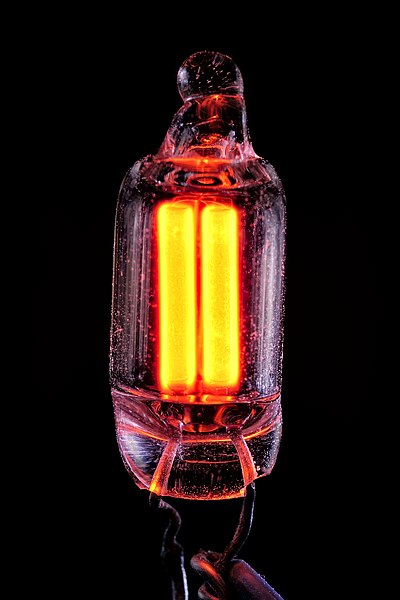
A neon lamp is a type of gas-discharge lamp, specifically a miniature glow lamp. Its operation hinges on the electrical ionization and excitation of a low-pressure gas mixture contained within a sealed glass envelope. The envelope typically houses two electrodes: an anode and a cathode.
When a sufficient voltage, known as the striking voltage, is applied across these electrodes, the electric field becomes strong enough to accelerate free electrons present in the gas. These energetic electrons collide with gas atoms, transferring energy and causing electron excitation to higher energy states. As these excited atoms relax back to their ground state, they emit photons.
In pure neon gas, this emission is predominantly in the red-orange spectrum (around 640 nm), giving the lamp its characteristic color. The visible glow is primarily a negative glow discharge, a thin luminous region that forms very close to the cathode. This is distinct from the positive column seen in larger neon signs, which utilizes a much longer path of ionized gas.
The low pressure is critical, as it allows electrons to gain enough energy between collisions to effectively ionize or excite the gas atoms without excessive scattering.
From Novelty to Necessity
The development of neon lamps is intrinsically linked to the broader exploration of gas discharge phenomena in the late 19th and early 20th centuries. Georges Claude is famously credited with developing the first practical neon gas discharge tubes for lighting and signage around 1910. These large, vibrant signs quickly became iconic.
However, the miniaturization of these lamps into small indicator units represented a significant engineering achievement. Before the widespread adoption of LEDs, neon glow lamps were the de facto standard for visual status indication in electronic equipment. Their simplicity, durability, and low power consumption made them ideal for indicating whether a device was powered on, a circuit was active, or a specific function was engaged.
They were integrated into countless appliances, scientific instruments, and control panels, becoming an indispensable part of early electronic design and user interfaces. Their historical significance lies in bridging the gap between experimental physics and practical electronic engineering.
Key Characteristics and Design Considerations
The defining characteristic of a neon lamp is its low-pressure gas fill and the resulting glow discharge. The specific gas mixture influences the color and operating characteristics. While pure neon produces a reddish-orange, adding other gases can shift the color.
The electrodes are typically made of materials that can withstand electron bombardment and gas ionization, such as tungsten. The operating voltage is a critical parameter; a striking voltage is needed to initiate the discharge, followed by a lower maintaining voltage to sustain it. This voltage-current characteristic makes them useful in certain high-voltage circuits, where they can act as voltage regulators or protective elements by shunting excess voltage.
The low pressure within the lamp is crucial for the mean free path of electrons, allowing them to accelerate sufficiently to cause excitation and ionization. The glass envelope must be able to withstand the operating conditions and contain the low-pressure gas.
Enduring Applications and Modern Relevance
Despite the advent of more energy-efficient and versatile technologies like LEDs, neon lamps continue to find application in specific niches. Their inherent simplicity and robustness make them reliable components in high-voltage systems, where they can serve as visual indicators or voltage limiters. For example, they might be found in power supplies, X-ray equipment, or other high-potential apparatus.
In some specialized scientific instruments or industrial controls, their unique glow characteristics or electrical properties are still preferred. Furthermore, the iconic aesthetic of neon lighting, even in miniature form, retains a certain appeal in artistic installations or retro-themed designs. While they may not be as ubiquitous as they once were, neon lamps represent a foundational technology in lighting and electronics, demonstrating enduring utility through their fundamental physical principles and robust design.
See also
Frequently Asked Questions
What is a neon lamp?+
Why does a neon lamp glow orange?+
How does a neon lamp start glowing?+
Where were neon lamps first used?+
Can neon lamps help protect electronic devices?+
Based on content from Wikipedia · Licensed under CC BY-SA 4.0