

National Palace (Mexico)
Images

National Palace (Mexico)


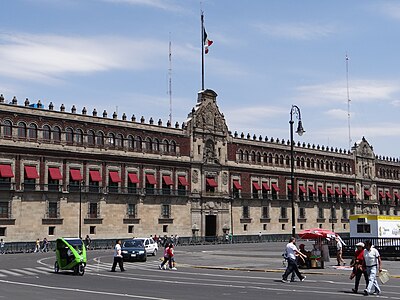


Geopolitical Nexus
The National Palace occupies a pivotal location in the geopolitical landscape of Mexico, situated on the Plaza de la Constitución (El Zócalo) in the historic center of Mexico City. This grand plaza, one of the largest urban public spaces globally, has historically been the nucleus of political, religious, and social life in the capital. The palace's placement here is no accident; it signifies its role as the epicenter of federal executive power.
Its presence on the Zócalo, surrounded by other significant institutions like the Metropolitan Cathedral, underscores its importance as a symbol of national sovereignty and governance. The surrounding urban fabric, characterized by dense population and historical architecture, further emphasizes the palace's central role in the nation's identity and daily life. The climate of Mexico City is temperate, with distinct wet and dry seasons, allowing for year-round activity and accessibility to this key governmental site.
Palimpsest of Power
The National Palace is a profound historical palimpsest, a structure built upon and incorporating remnants of previous eras. Its origins trace back to the Aztec capital, Tenochtitlan, where the palace of Moctezuma II once stood. Following the Spanish conquest in the 16th century, Hernán Cortés ordered the construction of his own residence on the same site, utilizing stones from the demolished Aztec palace.
This practice of reusing materials continued through subsequent reconstructions and expansions, most notably under Viceroyalty and later during the independent Mexican Republic. The current edifice, while largely a 17th-century Baroque structure, is thus intrinsically linked to its pre-Hispanic and colonial foundations. This continuous occupation and rebuilding by successive ruling powers imbue the palace with a unique historical resonance, making it a tangible link between Mexico's ancient past and its modern nationhood.
It stands as a testament to the enduring significance of this particular site for governance and power.
The Executive's Citadel
As the seat of the federal executive in Mexico, the National Palace houses the offices of the President and key administrative bodies. Since 2018, it has also served as the official presidential residence, consolidating its role as the primary locus of executive authority. This dual function highlights its ongoing evolution as a center of power.
The palace is not merely a symbolic edifice but a working government institution where policy is formulated, national directives are issued, and diplomatic engagements occur. Its historical role as a viceregal palace and later as the presidential residence reflects the continuity of centralized power structures in Mexico, albeit under different political systems. The sheer scale of the building accommodates numerous ministries and departments, facilitating the complex machinery of a modern state within a historically charged environment.
A Canvas of National Narrative
Beyond its governmental functions, the National Palace is celebrated as a monumental art gallery, most famously for the expansive murals by Diego Rivera. Commissioned in the 1920s and 30s, these vast artworks cover interior walls and staircases, narrating the comprehensive history of Mexico from its geological origins and indigenous civilizations through the Spanish conquest, the colonial period, the struggle for independence, and the Mexican Revolution.
Rivera's powerful imagery and narrative style transformed the palace into a public museum of national identity and historical consciousness. These murals are not merely decorative; they are didactic, intended to educate and unify the populace by presenting a shared, albeit often ideologically charged, vision of the nation's past and its ongoing journey. The palace thus serves a dual purpose: a functional seat of government and a profound cultural monument that shapes and reflects Mexican identity.
Education and National Identity
The National Palace functions as an informal educational institution, offering profound insights into Mexican history, culture, and governance. The presence of Diego Rivera's monumental murals provides a visual curriculum for visitors, illustrating key historical events, social struggles, and cultural achievements. These artworks serve as powerful pedagogical tools, fostering a sense of national identity and historical understanding among citizens and tourists alike.
By depicting the nation's complex past, including its triumphs and tribulations, the murals encourage reflection on Mexico's ongoing development and its place in the world. Furthermore, the palace itself, as a site of continuous governance since pre-Hispanic times, embodies the enduring nature of statehood and political evolution. Its accessibility, particularly the areas featuring the murals, allows for direct engagement with national narratives, making it a vital space for civic education and the cultivation of a shared historical consciousness.
The palace’s role extends beyond mere administration; it actively contributes to the cultural and historical education of the nation.
See also
Frequently Asked Questions
What is the National Palace in Mexico City?+
Where is the National Palace located?+
Why does the National Palace use stones from an old Aztec palace?+
Who lives and works inside the National Palace?+
What famous murals can you see inside the National Palace?+
Based on content from Wikipedia · Licensed under CC BY-SA 4.0