

Monte Cassino
Images

File:Bundesarchiv Bild 101I-577-1917-08, Monte Cassino, Fallschirmjäger mit Granatwerfer.jpg




Geographical and Spiritual Nexus
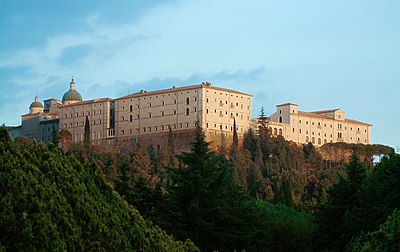
Perched atop a commanding rocky hill in Italy's Latin Valley, approximately 130 kilometers southeast of Rome, the Abbey of Monte Cassino occupies a site rich in both natural beauty and historical significance. Its strategic elevation offers panoramic views, historically vital for defense and observation. The region, once the location of the ancient Roman town of Casinum, benefits from a Mediterranean climate conducive to agriculture, a tradition maintained for centuries.
This geographical advantage has always intertwined with its spiritual mission, making it a beacon of Benedictine monasticism for over 1,500 years. The very act of establishing a monastery on such a prominent, defensible, yet accessible location underscores its intended role as a central hub for spiritual and cultural influence.
Founding Principles and Enduring Adaptations
Founded around 529 AD by Saint Benedict of Nursia, Monte Cassino holds the distinction of being the very first monastery of the Benedictine Order. It was here that Benedict composed his seminal 'Rule of Saint Benedict,' a comprehensive set of guidelines that would profoundly shape Western monasticism and influence European civilization for centuries. The abbey's history is a testament to remarkable resilience, marked by repeated destruction and subsequent rebuilding.
It was sacked by the Lombards around 570, abandoned, re-established in the 8th century, and then again by Saracens in 883. These cycles of devastation and reconstruction, often accompanied by periods of exile for the monastic community, highlight the unwavering commitment of its inhabitants to preserving their spiritual heritage and the teachings of Saint Benedict.
The Golden Age
The 11th and 12th centuries represent Monte Cassino's zenith, a period of immense influence and prosperity. The abbey expanded its temporal power, acquiring a vast territory known as the 'Terra Sancti Benedicti,' fortified with castles. Its cultural impact was equally significant; it fostered artistic endeavors, employing Byzantine artisans and maintaining strong ties with the Eastern Church, even receiving patronage from Byzantine emperors.
This era saw the rise of intellectual giants within its walls, including Cardinal Leo of Ostia and Peter the Deacon, who chronicled the abbey's history. The prestige of Monte Cassino was such that its abbot held precedence over all other abbots, and three popes emerged from its ranks: Stephen IX, Victor III, and Gelasius II, underscoring its profound influence on the Catholic Church.
Conflict and Reconstruction
By the 13th century, Monte Cassino's influence began to wane, and it became entangled in secular conflicts. Emperor Frederick II garrisoned troops there in 1239, and later, a devastating earthquake in 1349 necessitated extensive rebuilding efforts, funded by contributions from Benedictine monasteries across Italy. The abbey faced further challenges, including dissolution by the Italian government in 1866, after which it became a national monument.
Its most tragic chapter unfolded during World War II with the Battle of Monte Cassino in 1944. The historic abbey was almost completely destroyed by Allied bombing, a controversial act aimed at dislodging German forces. Post-war, a monumental effort was undertaken to reconstruct the abbey, meticulously recreating its former grandeur, serving as a powerful symbol of renewal and remembrance.
Modern Identity and Enduring Legacy
In the contemporary era, Monte Cassino continues its existence as a territorial abbey, though its administrative scope has been significantly redefined. Following reforms in 2014, its jurisdiction was reduced to the abbey itself, with its former parishes transferred to a local diocese. This adjustment reflects broader trends within the Catholic Church regarding territorial abbeys.
Despite these changes, the monastic community, though small, perseveres under the guidance of its abbot, the successor to Saint Benedict. Monte Cassino remains a vital center for Benedictine life, a profound historical site, and a poignant monument to human endurance, faith, and the enduring power of spiritual heritage against the backdrop of centuries of tumultuous history.
See also
Frequently Asked Questions
What is Monte Cassino?+
Why did people rebuild Monte Cassino many times?+
How did Monte Cassino help the world?+
Where is Monte Cassino located?+
Why was Monte Cassino destroyed in World War II?+
Based on content from Wikipedia · Licensed under CC BY-SA 4.0