

Mohs Scale: The Scratch-Resistant Superstars!
Images
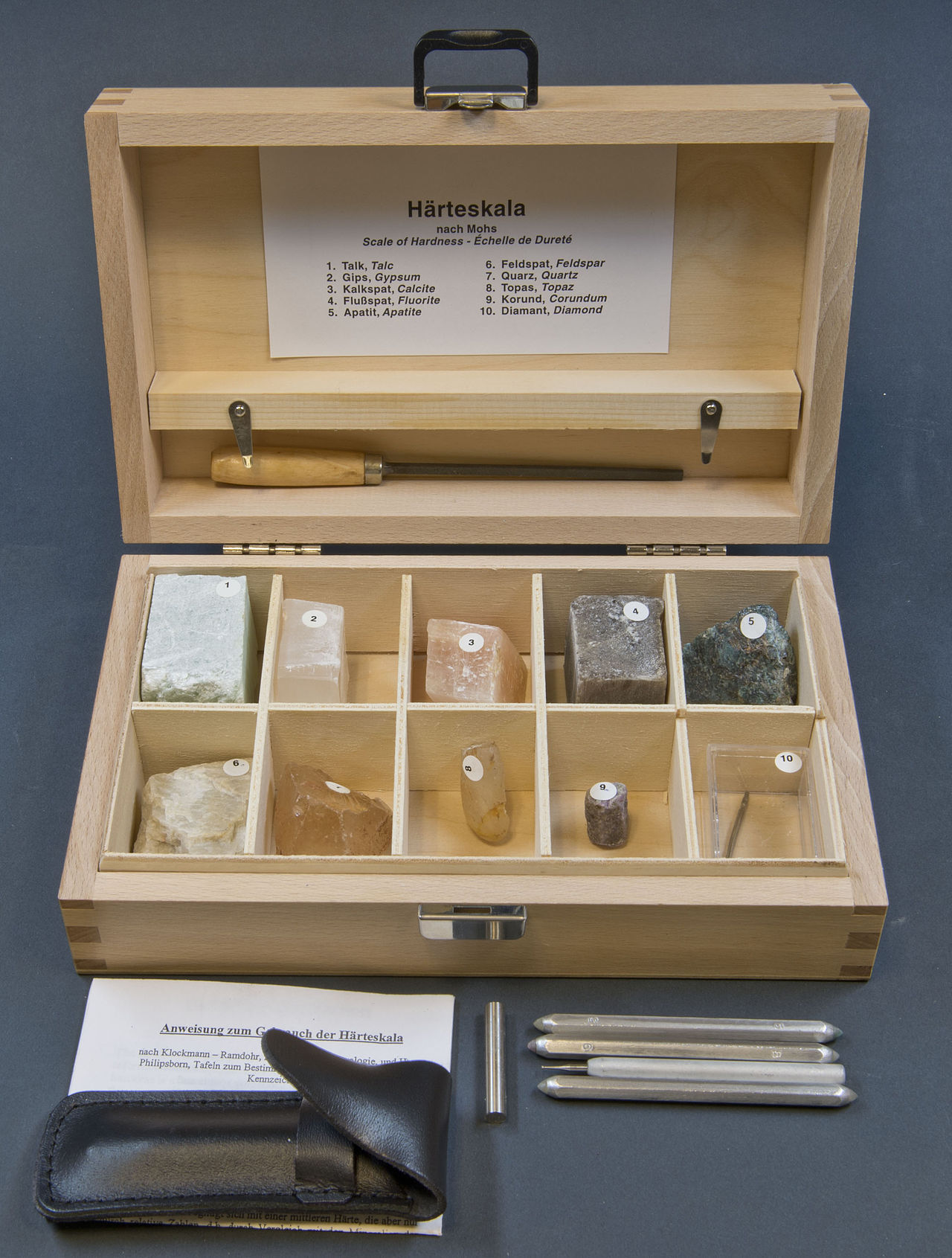
Mohs scale


The Genesis of a Comparative Hardness Scale
The Mohs scale, introduced by German mineralogist Friedrich Mohs in 1812, is a cornerstone of mineral identification. It is a qualitative, ordinal scale ranking ten reference minerals from 1 (talc) to 10 (diamond) based on their relative scratch resistance. This means a mineral higher on the scale can scratch any mineral lower than it.
Mohs’ innovation was to systematize the long-standing practice of using scratch tests for mineral identification, which had been noted by ancient scholars like Theophrastus and Pliny the Elder. His scale provides a practical and accessible method for geologists in the field, allowing for rapid preliminary identification without sophisticated laboratory equipment. The scale's enduring utility lies in its simplicity and its ability to provide a clear comparative framework for understanding a fundamental physical property of minerals.
Historical Context and Evolution of Hardness Measurement
The concept of mineral hardness as a distinguishing characteristic predates Mohs by millennia. Ancient texts reveal an awareness that certain stones possessed superior resistance to abrasion. However, Mohs’ contribution was to establish a standardized set of ten minerals as benchmarks.
Each mineral on his scale was chosen because it was demonstrably harder than the preceding one and softer than the succeeding one. This created a robust, albeit relative, ranking system. While Mohs’ scale is ordinal and not linear (the difference in hardness between diamond and corundum is far greater than between talc and gypsum), it effectively categorizes minerals for practical purposes.
Modern science employs quantitative hardness tests, such as the Vickers or Rockwell scales, which provide precise numerical values, but the Mohs scale remains invaluable for its ease of use and historical significance in mineralogy.
Practical Applications and Field Identification
The primary significance of the Mohs scale lies in its utility for field identification. Geologists, prospectors, and even amateur rock enthusiasts can carry a small set of Mohs minerals or common objects with known hardness values (e.g., a steel file at 6.5, a glass plate at 5.5, a copper penny at 3.5, and a fingernail at 2.5) to test unknown specimens. By observing which materials can scratch a sample and which the sample can scratch, one can quickly narrow down the possibilities for a mineral's identity.
For example, if a mineral is scratched by a steel file but scratches glass, its hardness is likely between 5.5 and 6.5. This rapid assessment is crucial in geological surveys and exploration, enabling efficient classification of rock samples before more detailed laboratory analysis.
Beyond Geology
The principles of scratch resistance, as quantified by the Mohs scale, extend into the realm of materials science and engineering. The durability of surfaces in countless applications is directly related to their hardness. For instance, the development of scratch-resistant coatings for optical lenses, smartphone screens, and automotive paints draws upon an understanding of hardness principles.
Materials scientists aim to create surfaces that can withstand abrasion and wear, often by incorporating harder compounds or creating specific microstructures. While industrial applications may utilize more precise quantitative scales, the Mohs scale provides a fundamental conceptual framework for understanding and comparing the relative toughness of materials, influencing material selection and product design to enhance longevity and performance.
Limitations and Modern Perspectives on Hardness
Despite its widespread use, the Mohs scale has inherent limitations. As an ordinal scale, it does not measure the absolute hardness of minerals; the intervals between the numbers are not uniform. For example, the difference in hardness between diamond (10) and corundum (9) is significantly greater than the difference between gypsum (2) and calcite (3).
Furthermore, hardness can be anisotropic, meaning it can vary depending on the crystallographic direction in which the scratch is made. Modern quantitative hardness tests, such as Vickers, Knoop, and Rockwell, provide precise, reproducible measurements that are essential for engineering and materials science applications where exact performance specifications are critical. Nevertheless, the Mohs scale remains a vital educational tool and a practical first step in mineral identification, bridging historical observation with contemporary scientific understanding.
Go deeper
Frequently Asked Questions
What is the Mohs scale?+
Why do geologists use the Mohs scale in the field?+
How does a mineral higher on the Mohs scale behave when tested?+
Where did the idea of using scratches to identify minerals come from?+
How is the Mohs scale useful for everyday products like phone screens?+
Based on content from Wikipedia · Licensed under CC BY-SA 4.0