

Millipede
Images

Millipede


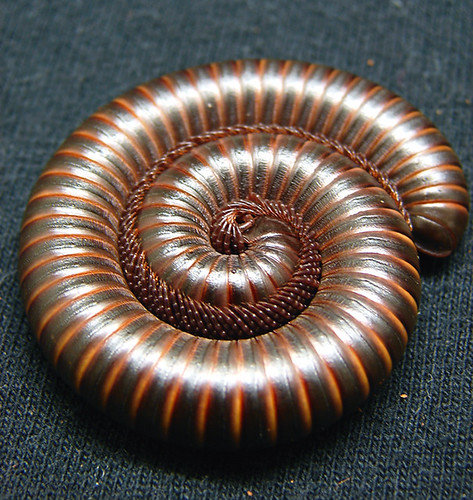


The Evolutionary Tapestry of Diplopoda
Millipedes, classified under the class Diplopoda, represent an ancient lineage of terrestrial arthropods with a fossil record stretching back to the Silurian period, over 400 million years ago. These early millipedes were among the first animals to colonize land, playing a pioneering role in terrestrial ecosystems. Their defining characteristic, the presence of two pairs of legs per diplosegment (formed by the fusion of two ancestral segments), is a key evolutionary adaptation that distinguishes them from other myriapods like centipedes.
This arrangement provides increased surface area for locomotion and burrowing, crucial for their detritivorous lifestyle. The development of a robust exoskeleton and specialized respiratory systems allowed them to thrive in terrestrial environments. Their evolutionary success is underscored by their global distribution and the incredible diversity within the class, with over 16,000 described species adapted to a wide range of habitats, from humid rainforests to arid regions, where they can find shelter and sustenance.
Morphological Marvels and Defensive Strategies
The morphology of millipedes is a testament to adaptation. The diplosegments, each bearing two pairs of legs, are highly specialized for efficient movement through soil and leaf litter. This leg arrangement provides stability and power for burrowing and navigating complex substrates.
Their mouthparts are adapted for chewing and grinding decaying organic matter, making them highly effective decomposers. When faced with threats, millipedes exhibit a remarkable array of defensive mechanisms. The most common is conglobation, where they coil into a tight ball, protecting their softer ventral side and presenting a hardened, unappetizing exterior to predators.
Many species also possess defensive glands, often located in ozadenes along their body, which secrete a cocktail of chemicals. These secretions can range from mildly irritating to highly toxic, serving to repel predators like birds, rodents, and insects. The specific chemical composition varies greatly among species, reflecting a co-evolutionary arms race with their natural enemies.
Ecological Keystone
Millipedes are indispensable components of terrestrial ecosystems, primarily functioning as detritivores and contributing significantly to nutrient cycling. By consuming vast quantities of dead plant material, such as fallen leaves, decaying wood, and other organic debris, they break down complex organic compounds into simpler substances. This process is crucial for releasing essential nutrients like nitrogen, phosphorus, and carbon back into the soil, making them available for uptake by plants.
Without millipedes and other decomposers, dead organic matter would accumulate, locking away vital nutrients and hindering plant growth. Their burrowing activities also aerate the soil, improving its structure and water infiltration. In essence, millipedes are ecological engineers, shaping soil structure and facilitating the flow of energy and nutrients through the ecosystem, thereby supporting biodiversity at multiple trophic levels.
Life Cycles, Longevity, and Conservation Considerations
The life cycle of a millipede typically begins with eggs laid in clutches within the soil or decaying organic matter. Upon hatching, the young millipedes, or nymphs, are often small and possess only a few leg-bearing segments. They grow through a series of molts, a process known as ecdysis, during which they shed their exoskeleton.
With each successive molt, they add new segments and pairs of legs, gradually developing into adult form. This extended development period contributes to their relatively long lifespans, which can range from a few years to over a decade for some larger species. While most millipede species are currently classified as Least Concern due to their widespread distribution, localized populations can be vulnerable to habitat destruction, pollution, and climate change.
Understanding their specific habitat requirements and ecological roles is crucial for effective conservation efforts, particularly for rare or endemic species.
See also
Frequently Asked Questions
What is a millipede?+
Why do millipedes have so many legs?+
How do millipedes protect themselves from predators?+
Where can you find millipedes?+
What do millipedes eat and why are they important?+
Based on content from Wikipedia · Licensed under CC BY-SA 4.0