

Mikoyan MiG-31
Images

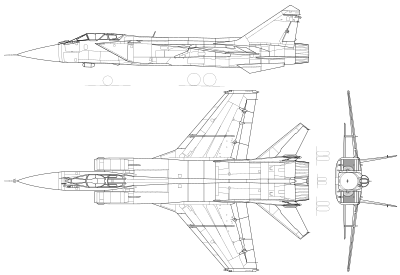
Mikoyan MiG-31 Foxhound '202 blue'



Evolution from the Foxbat
The Mikoyan MiG-31, designated 'Foxhound' by NATO, represents a significant leap in Soviet interceptor technology, building upon the legacy of its predecessor, the MiG-25 'Foxbat'. Developed by the Mikoyan design bureau, the MiG-31 was conceived during a period of intense technological competition, aiming to create an aircraft that could counter emerging threats with unparalleled speed and range. While sharing some design elements with the MiG-25, the MiG-31 incorporated substantial improvements in aerodynamics, propulsion, and avionics.
The primary objective was to create a dedicated long-range interceptor capable of defending vast Soviet airspace against high-speed, high-altitude bombers and reconnaissance aircraft. This involved a complete redesign of the airframe and the integration of more powerful engines, ensuring the aircraft could sustain supersonic speeds for extended durations and at higher altitudes than its predecessor.
Unrivaled Velocity
The defining characteristic of the MiG-31 is its extraordinary speed. It holds the distinction of being the fastest operational combat aircraft currently in service, with a maximum speed reported to be around 3,000 kilometers per hour (Mach 2.83). This phenomenal velocity is achieved through its powerful twin-engine configuration and advanced aerodynamic design, which minimizes drag at supersonic speeds.
This speed is not merely for show; it is a critical tactical advantage. It allows the MiG-31 to rapidly close distances to intercept targets, engage them, and return to base before enemy aircraft can react or escape. The ability to achieve and sustain such speeds makes it an exceptionally potent platform for air defense missions, capable of responding to threats across vast territories with remarkable efficiency.
Enduring Relevance in a Changing World
Despite the geopolitical shifts following the collapse of the Soviet Union in 1991, the MiG-31 has maintained its relevance and continues to be a cornerstone of the Russian Aerospace Forces. Its operational lifespan has been extended through significant modernization programs, with current plans indicating service until at least 2030. This longevity is a testament to its robust design and the ongoing upgrades that keep it effective.
The extension of its service life from 2,500 to 3,500 flight hours in 2020 underscores its continued importance. Furthermore, the development of specialized variants, such as the MiG-31K, which can carry the Kh-47M2 Kinzhal air-launched ballistic missile, highlights its adaptability and its role in projecting power with advanced weaponry, including conventionally or nuclear-capable warheads.
Advanced Systems for Superior Interception
The MiG-31's effectiveness as an interceptor is not solely due to its speed; it is also equipped with sophisticated radar and avionics systems. Its powerful Zaslon phased-array radar, one of the first of its kind, provides exceptional long-range detection and tracking capabilities, allowing it to engage multiple targets simultaneously. This advanced radar system is crucial for its role in defending large airspace sectors.
The aircraft's design also emphasizes crew coordination, with a two-person crew consisting of a pilot and a weapon systems officer who manage the complex sensor and weapon systems. This collaborative approach enhances situational awareness and operational effectiveness, ensuring the MiG-31 can perform its demanding interception missions with precision and efficiency.
Global Footprint and Strategic Significance
While primarily operated by Russia, the MiG-31 has also served with the Kazakh Air Defence Forces, though they retired the type in 2023. Its strategic significance lies in its ability to project air power and provide robust air defense over vast distances. The MiG-31's speed and range make it an ideal platform for patrolling remote areas and responding to potential incursions.
Its continued service, especially with the integration of advanced missile systems like the Kinzhal, positions it as a key component of Russia's modern military strategy, capable of deterring potential adversaries and responding to a wide spectrum of aerial threats. The aircraft's enduring presence in active service speaks volumes about its design excellence and its continued strategic value.
See also
Frequently Asked Questions
What is the MiG-31 and why is it called "Foxhound"?+
How fast can the MiG-31 fly and why is that important?+
What special radar does the MiG-31 have?+
Why does the MiG-31 still fly today even after the Soviet Union ended?+
What is the MiG-31K and what can it carry?+
Based on content from Wikipedia · Licensed under CC BY-SA 4.0