

Michelson–Morley Experiment
Images

Mm-velocity-add



The Aether Hypothesis and the Quest for Absolute Motion
In the late 19th century, the prevailing scientific model posited the existence of a luminiferous aether, a pervasive, massless, and undetectable medium thought to be essential for the propagation of light waves. This concept was analogous to how sound waves require a medium like air or water. If the aether existed, then light waves would travel through it at a constant speed, and the Earth, in its motion through the cosmos, would experience an 'aether wind.' Detecting this wind would allow scientists to measure the Earth's absolute velocity relative to this universal medium.
This was a fundamental pursuit, as understanding absolute motion was a cornerstone of classical physics. The Michelson–Morley experiment was conceived as the definitive test to either confirm the aether's existence and measure this motion or to reveal a profound inconsistency in the prevailing theories. The precision required was immense, aiming to detect differences in light speed on the order of one part in 10^8.
The Ingenious Interferometer
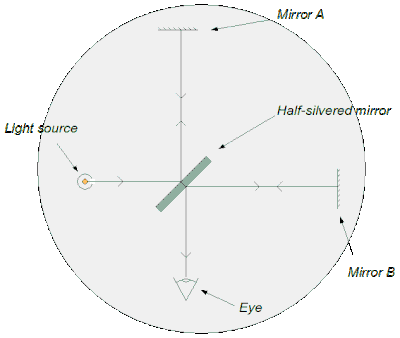
Albert Michelson, already renowned for his precise measurements of the speed of light, collaborated with Edward Morley to design and execute an experiment of unprecedented accuracy. They utilized a Michelson interferometer, a sophisticated optical device. This instrument works by splitting a single beam of light into two perpendicular beams using a half-silvered mirror (a beam splitter).
Each beam then travels along an equal path length to a separate mirror, reflects back, and recombines at the beam splitter. If the two beams travel at the same speed and cover the same distance, they will recombine in a predictable way, creating a specific interference pattern. However, if one beam were traveling through an 'aether wind' at a different speed than the other, their arrival times would differ, causing a shift in this interference pattern.
The experiment was meticulously set up on a heavy stone slab floating in a mercury trough to minimize vibrations, ensuring maximum sensitivity.
The Astonishing Null Result
The experiment was conducted over several months in 1887, with observations taken at different times of the day and year to account for potential variations in Earth's velocity relative to the hypothetical aether. The results were consistently and profoundly disappointing to the proponents of the aether theory. Michelson and Morley found no measurable difference in the speed of light between the two perpendicular paths.
The interference pattern remained virtually unchanged, indicating that the light beams arrived back simultaneously. This 'null result' was a stark contradiction to the expected outcome based on the aether hypothesis. It suggested that either the aether did not exist, or it behaved in ways that were entirely counterintuitive, perhaps being dragged along with the Earth, which itself contradicted other observations.
The precision of the experiment was so high that it ruled out many proposed aether theories.
Foundational Impact
The Michelson–Morley experiment's failure to detect the aether wind had a seismic impact on theoretical physics. It became one of the most famous negative results in scientific history, directly challenging the bedrock assumptions of the time. While initially met with confusion and attempts to salvage the aether theory, the experiment's implications could not be ignored.
It created a significant 'embarrassment' for physics, as Albert Einstein later noted. This experimental anomaly was a critical piece of evidence that, along with other theoretical considerations, led Einstein to develop his special theory of relativity in 1905. Special relativity postulates that the speed of light in a vacuum is constant for all inertial observers, irrespective of their motion or the motion of the light source, thereby eliminating the need for an aether.
Subsequent experiments, refined over decades, have repeatedly confirmed the constancy of the speed of light, solidifying the Michelson–Morley experiment's legacy as a pivotal moment that ushered in the era of modern physics.
See also
Frequently Asked Questions
What were Michelson and Morley trying to find with their experiment?+
How did the experiment use light to test for the aether wind?+
Why did they set the experiment on a heavy stone slab in mercury?+
What did the experiment find about the aether?+
How did this experiment change science?+
Based on content from Wikipedia · Licensed under CC BY-SA 4.0