

Menhir
Images

Los Menhires de La Coruña

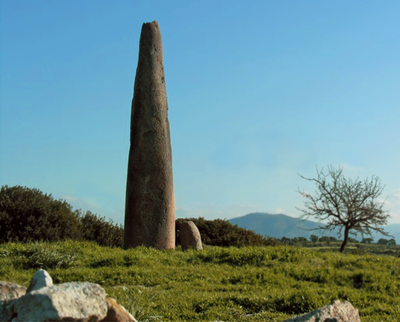


The Enigmatic Monolith
A menhir, derived from Brittonic terms for 'stone' (maen/men) and 'long' (hir/hîr), is fundamentally a large, upright stone deliberately emplaced by human agency. These megalithic structures, primarily dating from the European Middle Bronze Age, represent a significant investment of labor and societal organization. They are characterized by their solitary or clustered placement and often exhibit a tapering form towards their apex.
While the term 'orthostat' can also refer to such stones, 'menhir' specifically denotes a free-standing, upright monolith. The sheer scale of many menhirs, some reaching heights comparable to multi-story buildings, immediately signals their importance beyond mere geological features. They are artifacts of human intention, standing as silent, enduring markers on the landscape, prompting questions about the beliefs, capabilities, and social structures of the communities that erected them.
Their presence across vast geographical areas suggests shared cultural impulses or widespread technological diffusion.
Chronological and Geographical Footprints of Standing Stones
The phenomenon of menhir construction spans a considerable temporal and geographical range, though a notable concentration exists in Western Europe, particularly in regions like Ireland, Great Britain, and Brittany. While often associated with the Middle Bronze Age, the precise dating can vary, with some scholars suggesting earlier Neolithic origins for certain megalithic traditions that include standing stones.
Their distribution extends beyond Europe, appearing in parts of Africa and Asia, indicating a widespread human practice of erecting monumental stones. This geographical spread necessitates consideration of both independent innovation and potential cultural exchange networks. Understanding the specific environmental and cultural contexts in which different menhirs were erected is crucial for interpreting their varied roles.
The concentration in Western Europe, for instance, has led to extensive research into the Neolithic and Bronze Age societies of these areas, linking menhirs to broader megalithic landscapes and monumentality.
Hypotheses on Purpose
The precise function of menhirs remains a subject of ongoing debate and speculation among archaeologists. Hypotheses range widely, reflecting the multifaceted nature of prehistoric societies. One prominent theory suggests their use in druidic rituals or other forms of ancient religious ceremonies, serving as focal points for worship, sacrifice, or community gatherings.
Their placement in alignment with celestial events, such as solstices or equinoxes, has also led to theories of astronomical significance, acting as calendars or observatories. Alternatively, menhirs may have functioned as territorial markers, delineating boundaries between tribal lands, settlements, or sacred areas. Furthermore, they could have been integral components of a complex ideological system, reinforcing social hierarchies, commemorating ancestors, or symbolizing collective identity.
The presence of anthropomorphic figures and symbolic engravings on some menhirs lends credence to their role in conveying meaning and narrative, connecting the physical stone to abstract concepts and beliefs.
Construction and Engineering
The erection of menhirs represents a remarkable feat of prehistoric engineering and labor mobilization. The process would have begun with the selection and quarrying of suitable stone, often large granite or sandstone blocks. Shaping the stone, if undertaken, would have been achieved through pounding with harder stones or by using techniques like fire-setting to crack the rock.
Transportation from the quarry to the final site was perhaps the most challenging phase, likely involving the use of sledges, rollers, and extensive manpower, possibly aided by animal traction. At the erection site, various methods could have been employed, including digging a large pit and levering the stone upright using ropes and timber beams, or constructing ramps to gradually tilt the monolith into its vertical position. The stability of these massive stones, some standing for millennia, attests to the careful planning and execution involved.
The sheer effort required underscores the profound importance these structures held for their builders.
Menhirs in Context
Menhirs are rarely isolated phenomena; they are often integrated into broader prehistoric landscapes, frequently appearing in proximity to other megalithic structures such as stone circles, dolmens, and burial mounds. This contextualization is vital for understanding their role within larger ceremonial or social complexes. The engravings found on some menhirs are particularly significant, offering rare glimpses into the artistic expression and symbolic language of prehistoric peoples.
These carvings, depicting abstract symbols or stylized human forms, provide tangible evidence of the cultural narratives and belief systems associated with these monuments. The legacy of menhirs extends beyond their archaeological significance; they continue to inspire awe and curiosity, serving as powerful reminders of humanity's ancient past and our enduring drive to create lasting monuments that speak across the ages. They are tangible links to ancestral traditions and a testament to the deep-seated human impulse to mark and imbue the landscape with meaning.
See also
Frequently Asked Questions
What is a menhir?+
Where can you find menhirs?+
Why are menhirs so tall and special?+
How did people build menhirs?+
What did people use menhirs for?+
Based on content from Wikipedia · Licensed under CC BY-SA 4.0