

Maxwell–Boltzmann Distribution
Images

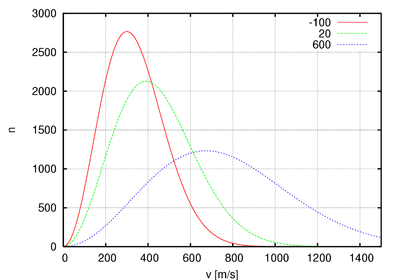
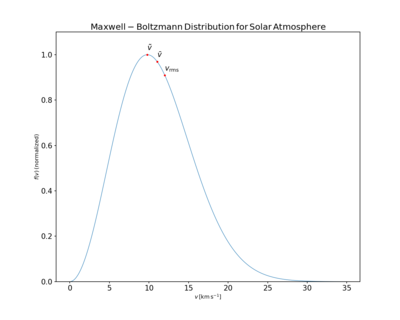
Distribution de Maxwell-Boltzmann. Distribution de l'inverse des vitesses de l'hélium à 5500 K




The Statistical Foundation of Particle Motion
The Maxwell-Boltzmann distribution is a fundamental probability distribution in statistical mechanics that quantifies the speeds of particles within an idealized gas system at thermodynamic equilibrium. It posits that particles, assumed to move freely and interact only through brief collisions, exhibit a spectrum of speeds. This distribution is not deterministic for any single particle but describes the likelihood of finding a particle within a specific speed range.
It arises from the kinetic theory of gases, which models macroscopic gas properties like pressure and temperature as emergent behaviors from the collective motion of countless microscopic particles. The distribution is mathematically represented as a chi distribution with three degrees of freedom, scaled by temperature and particle mass.
Historical Genesis
The concept was initially formulated by James Clerk Maxwell in 1860 through heuristic reasoning, focusing on the statistical behavior of gas molecules. He recognized that a predictable pattern governed particle speeds, even amidst random motion. Ludwig Boltzmann significantly advanced this understanding in the 1870s, providing deeper physical insights and rigorous mathematical derivations. Boltzmann's work emphasized that the Maxwell-Boltzmann distribution arises naturally from the principle of maximizing the system's entropy under constraints, such as the conservation of average energy.
This connection to entropy and statistical ensembles, like the canonical ensemble, solidified its place as a cornerstone of statistical physics.
Profound Implications for Physical Phenomena
The significance of the Maxwell-Boltzmann distribution extends far beyond theoretical physics. It provides the foundational explanation for numerous macroscopic gas properties. For instance, gas pressure is directly related to the rate and force of particle collisions with container walls, which is dictated by their speeds. Diffusion, the spontaneous mixing of gases, is driven by the random motion and varying speeds of particles.
Understanding this distribution is critical for fields like thermodynamics, fluid dynamics, and astrophysics, enabling predictions about gas behavior in diverse environments, from planetary atmospheres to stellar interiors. It also informs the design and efficiency of technologies involving gases, such as internal combustion engines and refrigeration systems.
Mechanisms of Speed Distribution
The Maxwell-Boltzmann distribution emerges from the continuous process of collisions between gas particles. During these collisions, energy and momentum are exchanged, leading to a redistribution of speeds. While individual particles may accelerate or decelerate dramatically during a collision, the overall statistical distribution of speeds tends towards a stable equilibrium state, characterized by the Maxwell-Boltzmann curve.
This equilibrium is reached when the rate of particles gaining speed equals the rate of particles losing speed. The temperature of the gas is a direct measure of the average kinetic energy of its particles, and thus directly influences the shape and peak of the Maxwell-Boltzmann distribution, with higher temperatures resulting in a broader distribution and higher average speeds.
Scope and Limitations
The Maxwell-Boltzmann distribution is derived for an ideal gas model, which assumes point-like particles with negligible volume and no intermolecular forces except during instantaneous collisions. Consequently, it provides an excellent approximation for rarefied gases at moderate temperatures, where these assumptions hold reasonably well. However, real gases deviate from this ideal behavior due to factors like finite particle volume (van der Waals forces), inter-particle attractions and repulsions, and quantum mechanical effects at very low temperatures or high densities.
For instance, at very high speeds approaching the speed of light, relativistic effects become significant. In such non-ideal scenarios, more complex distribution functions are required.
See also
Frequently Asked Questions
What is the Maxwell-Boltzmann distribution?+
Why do gas particles have different speeds?+
How does temperature change the distribution?+
Who first described the Maxwell-Boltzmann distribution?+
Why is this distribution useful for things like engines and refrigerators?+
Based on content from Wikipedia · Licensed under CC BY-SA 4.0