

Mathilde, Abbess of Essen
Images

Mathildenkreuz-Domschatz-Essen-2025
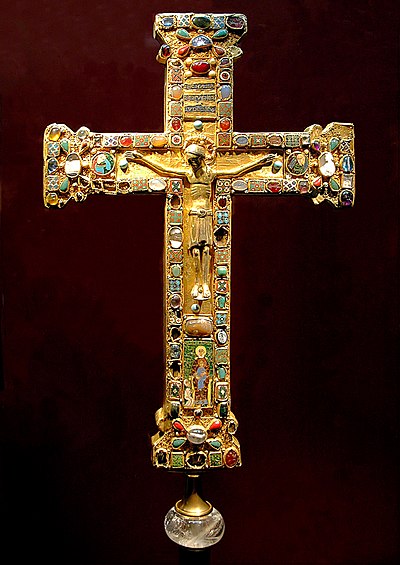

The Administrative Architect of Essen Abbey
Mathilde's tenure as Abbess of Essen Abbey, spanning from 973 to her death in 1011, marked a period of significant development and consolidation for the institution. She was not merely a spiritual figurehead but a highly capable administrator, responsible for the physical infrastructure of the abbey, its considerable material wealth, and its complex network of political relationships. Her leadership extended to the meticulous care of precious relics and liturgical vessels, items that held immense religious, cultural, and economic value.
In an era where women in positions of significant power were relatively rare, Mathilde’s long and successful leadership demonstrates exceptional competence and influence. She navigated the intricate political landscape of the Holy Roman Empire, ensuring the abbey's security and prosperity through strategic alliances and diplomatic engagement, solidifying its status as a major ecclesiastical center.
Patronage of Learning and Translation
Beyond her administrative duties, Mathilde was a crucial patron of intellectual and cultural life within Essen Abbey. Recognizing the importance of knowledge dissemination, she actively commissioned translations of significant texts. This initiative was vital for preserving and spreading religious and scholarly works, making them accessible to a wider audience within the monastic community and potentially beyond.
Her oversight of education within the abbey ensured that future generations of nuns and scholars would be well-equipped. This commitment to intellectual pursuits positioned Essen Abbey not just as a place of worship but as a vibrant center for learning and the transmission of culture during a formative period of European history. Her efforts contributed to the abbey's reputation as a repository of knowledge and a hub for intellectual discourse.
The Enigma of Mathilde II and Historical Succession
The historical record presents a fascinating complexity regarding Mathilde's identity, particularly the designation 'Mathilde II.' This appellation arises from a later, potentially unreliable, list of abbesses that suggests an earlier Mathilde governed Essen Abbey from 907 to 910. The historicity of this first Mathilde remains a subject of scholarly debate, casting a shadow of uncertainty over the abbey's early succession. This ambiguity necessitates careful historical analysis when discussing Mathilde's legacy, distinguishing between the well-documented Abbess of the late 10th and early 11th centuries and the possibly apocryphal predecessor.
The need for this distinction highlights the challenges of reconstructing medieval history from fragmented and sometimes contradictory sources, underscoring the critical role of source criticism in historical scholarship.
Enduring Significance and Legacy
Mathilde's significance transcends her immediate administrative achievements; she represents a powerful example of female leadership and agency in the medieval period. Her ability to manage a multifaceted institution, including its spiritual, economic, and political dimensions, challenges traditional narratives that often marginalize women's roles in history. Her dedication to preserving and enhancing the abbey's material and intellectual assets ensured its continuity and influence.
The treasures she safeguarded, such as the famous Essen Cathedral Treasury's collection, continue to be studied and admired today, offering tangible links to her era. Mathilde's legacy is thus embedded in the physical artifacts, the intellectual traditions, and the enduring institutional strength of Essen Abbey, making her a pivotal figure in understanding medieval ecclesiastical governance and cultural patronage.
Material Culture and Spiritual Authority
Mathilde's role as guardian of Essen Abbey's material culture was intrinsically linked to her spiritual authority. The relics and liturgical vessels under her care were not mere possessions but instruments of divine power and symbols of the abbey's prestige. Her meticulous management of these items, ensuring their preservation and appropriate use, reinforced the abbey's spiritual legitimacy and its connection to sacred history.
The commissioning of new works and the maintenance of existing treasures also served to enhance the abbey's visual splendor and devotional impact. This careful curation of material wealth was essential for projecting the abbey's status and influence within the broader political and religious landscape of the Holy Roman Empire, demonstrating how spiritual leadership was often intertwined with the management of significant material resources.
See also
Frequently Asked Questions
Who was Mathilde, Abbess of Essen?+
What did Mathilde do to help the abbey grow?+
How did Mathilde support learning and books?+
Why is Mathilde an example of strong women in history?+
Is there another Mathilde who might have been abbess before her?+
Based on content from Wikipedia · Licensed under CC BY-SA 4.0