

Mast (sailing)
Images

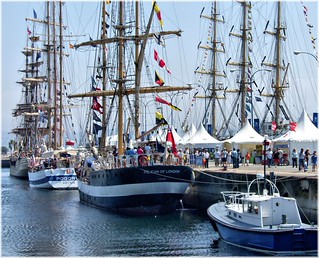
2818-Buque escuela Mexicano Cuauhtemoc en la Tall Ships Race-Coruña.2012.




![War of 1812: New Orleans [Image 4 of 32]](https://live.staticflickr.com/7190/6944368958_b787b9b406_n.jpg)
The Mast
The mast, a near-vertical spar or assembly of spars, is the quintessential element of a sailing vessel's propulsion system. Its primary function is to provide the structural integrity necessary to support sails, which act as aerodynamic surfaces. Beyond sail support, masts are multi-functional, often serving as platforms for navigation lights, lookout posts, signal yards, control stations, and communication equipment like radio aerials.
The configuration and number of masts are dictated by the vessel's design, size, and intended purpose, ranging from a single mast on a small sloop to multiple masts on large square-rigged ships. The inherent forces acting on a mast are significant, requiring robust engineering and careful consideration of material strength and stability, often necessitating guying (support from external ropes or wires) for larger structures.
Aerodynamics and Hydrodynamics
The mast's critical role lies in its ability to position sails effectively to capture wind energy. By holding sails aloft, it allows them to access higher, more consistent wind currents, which are less affected by surface friction and turbulence. The mast, in conjunction with the hull and keel (or centerboard), translates the wind's force into forward motion.
The angle and shape of the sails, controlled by the mast and rigging, are manipulated to optimize the lift and drag forces generated by the wind. This interaction between the mast, sails, wind, and water is a complex interplay of aerodynamics and hydrodynamics, where the mast acts as the crucial intermediary, converting atmospheric energy into kinetic energy for the vessel.
Evolution of Mast Construction
Historically, masts were exclusively fashioned from wood. Until the mid-19th century, the ideal mast was a single, tall, straight trunk of a conifer tree. However, the increasing size of ships rendered this practice insufficient.
To meet the demand for taller and thicker masts, a sophisticated construction technique known as 'made masts' emerged. These were built from multiple timber sections, stacked and joined together, typically comprising a lower mast, top mast, topgallant mast, and sometimes a royal mast. For even greater strength and to achieve the required diameter, the lower sections themselves could be constructed from several pieces of wood.
This evolution from natural, single-piece 'pole masts' to complex, multi-section 'made masts' was a significant engineering feat, enabling the construction of larger and more capable sailing vessels that facilitated global exploration and trade.
The Mast's Enduring Legacy in Maritime Technology
The development of the mast is intrinsically linked to the history of human civilization, enabling long-distance travel, trade, and cultural exchange for millennia. The specialized craft of mastmaking became a vital trade, requiring deep knowledge of timber properties and structural mechanics. While modern maritime transport relies heavily on engine power, the principles of mast and sail design continue to influence naval architecture and are central to recreational sailing and specialized applications like wind-assisted cargo ships.
The mast represents a foundational technology that allowed humanity to conquer the seas and remains a powerful symbol of maritime endeavor and ingenuity.
Modern Applications and Innovations
Although engine power dominates commercial shipping, the mast's role has not vanished. In recreational sailing, masts are essential, with designs continuously refined for performance and durability, often utilizing materials like aluminum alloys or carbon fiber composites for lighter weight and increased strength. Furthermore, there's a resurgence of interest in wind-assisted propulsion for cargo ships, employing modern sail technologies, including rigid wing sails and rotor sails, which are essentially advanced forms of masts.
These innovations aim to reduce fuel consumption and environmental impact, demonstrating that the fundamental concept of the mast, though ancient, continues to be a platform for cutting-edge maritime technology.
See also
Frequently Asked Questions
What is a mast on a sailing boat?+
Why do masts need to be strong and sometimes have ropes attached?+
How do masts help sails catch wind better?+
How did people make masts before modern materials?+
What other things can be put on a mast besides sails?+
Based on content from Wikipedia · Licensed under CC BY-SA 4.0