

Marshall Amplification
Images

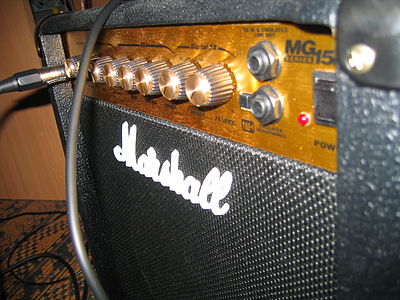
1930s double bass, 1960-70s Marshall amp - Instruments seeking amplification exhibit, EMP Museum




Genesis of a Sonic Powerhouse
Marshall Amplification emerged in 1962 from the practical needs of London's burgeoning music scene. Jim Marshall, a drummer and music shop owner, recognized a critical gap: existing amplifiers, primarily American imports like Fender, were perceived by many musicians as lacking the necessary volume and tonal character for the increasingly demanding live performances. Guitarists like Pete Townshend of The Who voiced these frustrations, seeking amps that could cut through the mix with greater power and a distinct voice.
This direct feedback loop fueled Marshall's ambition to create an alternative. The company's inaugural model, the JTM45 (1963), was a direct response, initially based on Fender's Bassman circuit but soon diverging to establish its own sonic identity. This foundational period was characterized by a commitment to innovation driven by the artists themselves, setting a precedent for the company's future development.
The 'Plexi' Era and the Birth of Iconic Tones
The relentless pursuit of volume and tonal refinement led Marshall to develop higher-wattage amplifiers. The introduction of 100-watt models, most notably the 1959 Super Lead in 1965, marked a significant leap. These amplifiers, easily identifiable by their distinctive Plexiglass control panels, earned the enduring nickname 'Plexis.' The raw, powerful, and harmonically rich sound produced by these amps resonated deeply with a generation of groundbreaking guitarists.
The adoption of Plexis by titans such as Jimi Hendrix, Eric Clapton, and Jimmy Page was not merely a commercial endorsement but a cultural phenomenon. Their performances, amplified by Marshalls, defined the sound of rock music, imbuing the brand with an almost mythical status and establishing a benchmark for amplifier performance that continues to influence designs today.
Evolution and Diversification
Marshall Amplification demonstrated remarkable adaptability throughout its history, consistently evolving its product lines to meet changing musical landscapes. The 1981 introduction of the JCM800 series proved pivotal, offering a more aggressive, higher-gain sound that became indispensable for the burgeoning hard rock and heavy metal genres. This series cemented Marshall's dominance in these heavier styles.
The company celebrated its 25th anniversary in 1987 with the release of the Silver Jubilee, a limited-edition model showcasing advanced features. Subsequent decades saw further refinement and expansion with the JCM900 and JCM2000 series, alongside the development of new lines like the DSL (Dual Super Lead) and JVM (Jim Vallance) models. This continuous innovation ensured Marshall remained relevant, offering a diverse range of tones from classic crunch to modern high-gain.
The Enduring Appeal of Tube Technology and Modern Integration
A defining characteristic of Marshall Amplification, particularly its revered models, is the continued reliance on vacuum tubes (valves) for sound amplification. Despite the prevalence of solid-state and digital modeling technologies, tubes remain the preferred choice for many musicians due to their unique tonal qualities: warmth, dynamic response, and natural overdrive characteristics. Marshall expertly crafts these tube amps, but also embraces technological advancements.
The company produces solid-state amplifiers for affordability and reliability, hybrid amps that blend tube warmth with solid-state practicality, and sophisticated digital modeling amplifiers that can emulate a vast array of sounds. This multi-faceted approach ensures that Marshall continues to offer sonic solutions for a wide spectrum of musicians, from beginners to seasoned professionals, maintaining its status as an industry leader.
Corporate Evolution and Global Reach
In recent years, Marshall Amplification has undergone significant corporate restructuring. Since 2023, the company operates as a division of the Marshall Group, a Swedish conglomerate. This group holds a majority stake owned by the China-based HongShan Capital Group.
While the ownership structure has evolved, the core identity and manufacturing ethos of Marshall Amplification remain focused on producing high-quality audio equipment. This global integration allows the brand to continue its legacy, reaching new markets and audiences while striving to uphold the sonic standards that have made 'Marshall' a globally recognized symbol of powerful, iconic guitar sound across decades of music history.
See also
Frequently Asked Questions
What is a Marshall amp?+
Why did musicians want Marshall amps in the 1960s?+
How did Marshall amps become famous with rock stars?+
What makes Marshall amps sound special compared to other amps?+
Are Marshall amps still made today and what kinds are there?+
Based on content from Wikipedia · Licensed under CC BY-SA 4.0