

Map projection
Images
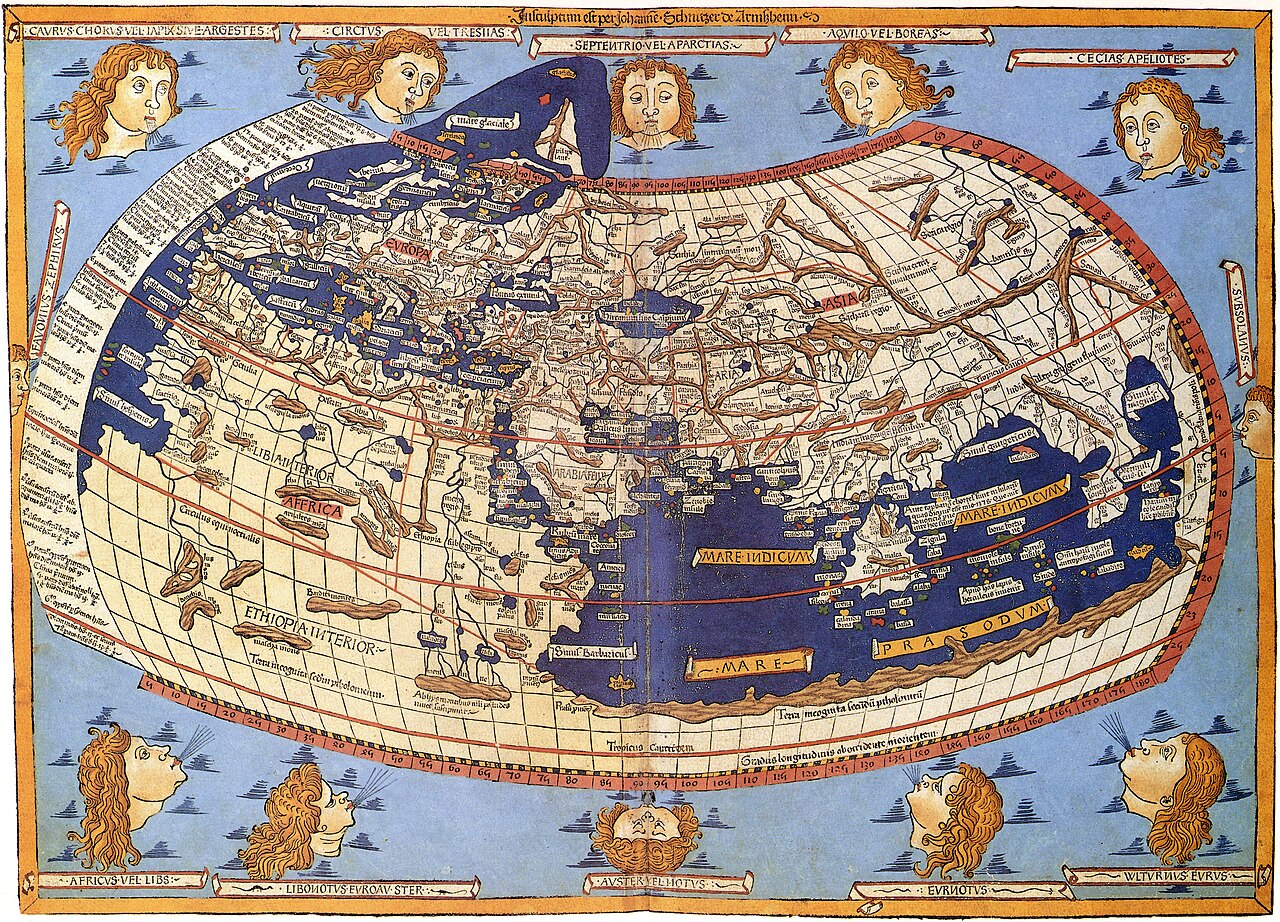
Map projection
The Fundamental Challenge
Map projection is the mathematical process of transforming the spherical or ellipsoidal coordinates of locations on the Earth's surface into Cartesian coordinates on a flat plane. This is a foundational concept in cartography, as all two-dimensional maps are the result of such a transformation. The inherent challenge lies in the fact that a curved surface cannot be perfectly represented on a flat surface without introducing distortions.
This is analogous to trying to flatten a segment of a sphere without stretching, tearing, or compressing it – an impossibility. Therefore, every map projection is a compromise, preserving certain properties at the expense of others. The study of map projections is largely the study and characterization of these inevitable distortions in area, shape, distance, and direction.
Classifying Distortions and Projection Types
Map projections are classified based on which properties they preserve. Conformal projections, like the Mercator, preserve angles and shapes locally, making them invaluable for navigation where maintaining directional accuracy is paramount. However, they dramatically distort areas, especially at higher latitudes.
Equal-area (or equivalent) projections, such as the Sinusoidal or Gall-Peters, maintain the correct relative sizes of landmasses, crucial for understanding global population distribution or resource allocation. Yet, these projections often distort shapes and angles significantly. Equidistant projections preserve distances from one or two central points to all other points on the map, useful for specific applications like airline route planning.
Azimuthal projections preserve direction from a central point. Most practical projections are not perspective projections, which are derived from a literal geometric projection from a point source of light; rather, they are mathematical functions that smoothly map coordinates from the curved surface to the plane.
The Mercator Projection
The Mercator projection, developed by Gerardus Mercator in 1569, is perhaps the most widely recognized map projection. Its primary advantage is its conformality, meaning that a course of constant compass bearing (a rhumb line) is represented as a straight line. This made it revolutionary for maritime navigation.
However, its significant area distortion has led to considerable criticism. For instance, Greenland appears larger than Africa on a Mercator map, despite Africa being approximately 14 times its size. This distortion can lead to a skewed perception of the relative sizes and importance of countries, particularly those in the Southern Hemisphere.
This has prompted the use of alternative projections in educational and general-purpose contexts.
Modern Cartography and Compromise Projections
In contemporary cartography, compromise projections are frequently employed for world maps. These projections aim to balance the various types of distortion rather than perfectly preserving any single property. Examples include the Robinson projection, which offers a visually pleasing representation with moderate distortions across the board, and the Winkel tripel projection, favored by organizations like the National Geographic Society for its balanced compromise between area, shape, distance, and direction.
The choice of projection ultimately depends on the map's intended purpose and audience. The mathematical principles of projection also extend beyond terrestrial mapping, finding applications in fields like astronomy and computer graphics, demonstrating the universality of transforming curved spaces onto flat representations.
The Mathematical Underpinnings and Infinite Possibilities
The concept of map projection is deeply rooted in mathematics, particularly in differential geometry and projective geometry. A projection can be viewed as a function that maps points from one manifold (the Earth's surface) to another (the plane). There is theoretically no limit to the number of possible map projections; for every mathematical function that smoothly transforms coordinates from the sphere to the plane, a unique projection can be defined.
While many projections are based on conceptual geometric models (like cylindrical, conical, or azimuthal), the vast majority in practical use are derived from complex mathematical formulas. Understanding these formulas and their resulting distortions is key to critically interpreting any map and appreciating the intricate relationship between our 3D world and its 2D representations.
Go deeper
Based on content from Wikipedia · Licensed under CC BY-SA 4.0