

Mamba: The Speedy Serpent!
Images

Mamba


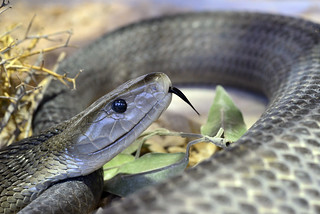


Taxonomy and Evolutionary Adaptations of the Dendroaspis Genus
The mamba genus, Dendroaspis, comprises four distinct species of venomous elapids native to Africa: the black mamba (Dendroaspis polylepis), the eastern green mamba (Dendroaspis angusticeps), the western green mamba (Dendroaspis viridis), and Jameson's mamba (Dendroaspis jamesoni). These snakes are characterized by their exceptionally slender, elongated bodies, which are a testament to their arboreal and terrestrial agility. Their speed is a primary adaptation, allowing them to strike prey with remarkable swiftness and also to escape potential threats efficiently.
The green mambas, in particular, exhibit remarkable camouflage, blending seamlessly with foliage, while the black mamba's dark mouth lining serves as a startling visual deterrent when it feels threatened. Their skeletal structure and musculature are finely tuned for rapid locomotion, making them among the fastest snakes globally, capable of covering significant distances in short periods.
Ecological Niches and Distribution
Mambas occupy diverse ecological niches across sub-Saharan Africa, demonstrating significant habitat plasticity. The black mamba, often found in savannas, woodlands, and rocky hills, is primarily terrestrial but can also climb trees. In contrast, the green mambas are predominantly arboreal, inhabiting forests and dense woodlands where they navigate the canopy with ease.
Jameson's mamba shares similar forest habitats. Their distribution spans a vast geographical area, from East Africa to West Africa, and southwards. This wide range is supported by their ability to exploit various food sources and find suitable shelter, whether in tree hollows, dense undergrowth, or even abandoned burrows and termite mounds.
Their presence is indicative of healthy ecosystems, as they play a crucial role as apex predators within their respective environments.
Dietary Strategies and Predatory Behavior
As obligate carnivores, mambas are highly effective predators. Their diet primarily consists of small to medium-sized mammals, including rodents, squirrels, hyraxes, and occasionally young monkeys or birds. Their hunting strategy is a combination of stealth and explosive speed.
They often employ an ambush technique, lying in wait before launching a rapid strike. The venom of mambas, particularly the potent neurotoxins found in the black mamba, acts quickly to immobilize prey, facilitating consumption. After a successful strike, the snake will often release its prey and track it by scent until the venom takes full effect, preventing escape and minimizing struggle.
This efficient predatory behavior is vital for their energy balance and survival in competitive environments.
Physiology, Venom, and Conservation Status
Mambas are long-lived snakes, with lifespans in the wild typically ranging from 10 to 12 years, though they can live longer in captivity. The black mamba, the longest venomous snake in Africa, can reach lengths of up to 14 feet (4.3 meters). Their venom is a complex cocktail of neurotoxins, cardiotoxins, and other compounds that can cause rapid paralysis and respiratory failure in humans if untreated.
While mambas are generally reclusive and avoid confrontation, their potent venom necessitates extreme caution. Fortunately, effective antivenoms are available, significantly reducing mortality rates from bites. Most mamba species are currently classified as 'Least Concern' by the IUCN, indicating stable populations.
However, habitat destruction due to agriculture and urbanization poses a significant threat to their long-term viability, highlighting the need for continued conservation efforts and public education to foster coexistence.
See also
Frequently Asked Questions
What makes mambas the fastest snakes in Africa?+
How do green mambas hide from predators?+
What do mambas eat and how do they catch their food?+
Why is the black mamba's mouth lining important?+
Are mambas dangerous to humans and how can people stay safe?+
Based on content from Wikipedia · Licensed under CC BY-SA 4.0