

Maluku (province)
Images

True sago palm starch product,papeda,gata-gata(Hatusua,W.Seram,Maluku,ID thu01oct2009-1324h)


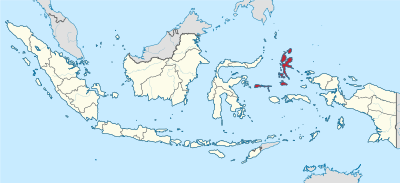


Geographical Context and Administrative Divisions
Maluku province is a significant component of Indonesia's vast eastern territories, strategically situated within the Maluku Islands archipelago. Its geographical definition is crucial: it encompasses the central and southern portions of these islands, lying between Sulawesi to the west and the island of New Guinea to the east. This positioning places it at a crossroads of maritime routes and diverse ecosystems.
The province's administrative boundaries are intricate, sharing borders with North Maluku and the westernmost parts of Papua to the north, Central and Southeast Sulawesi to the west, and extending south towards Australia and Timor-Leste across the Banda Sea. To the east, it is bordered by the Arafura Sea and the central and southern regions of Papua. The total land area of 46,158.26 km² is distributed across numerous islands, presenting considerable challenges for governance and infrastructure development.
The population, which grew from approximately 1.53 million in 2010 to over 1.94 million by mid-2024, is concentrated in various island settlements, with Ambon City on Ambon Island serving as the provincial capital and primary urban center. This dispersed population and island geography are fundamental to understanding Maluku's socio-economic and political landscape.
Historical Evolution of Provincial Status
The administrative history of Maluku is marked by significant restructuring, reflecting broader national policies and regional dynamics. From 1950, following Indonesia's independence, all the Maluku Islands were consolidated into a single, expansive province. This period fostered a unified provincial identity and administrative framework for decades.
However, by the late 20th century, demographic shifts and regional aspirations led to a re-evaluation of this structure. In 1999, a pivotal decision was made to bifurcate the original province. The northern territories, including the Maluku Utara Regency, Halmahera Tengah Regency, and the city of Ternate, were officially separated to form the new province of North Maluku (Maluku Utara).
This division, demarcated by the Seram Sea, fundamentally altered the geographical and administrative scope of the remaining province, which continued as Maluku (often implicitly referred to as South Maluku Province in historical contexts to distinguish it). This administrative division aimed to improve regional governance and responsiveness but also created distinct developmental trajectories for the two provinces.
Religious Pluralism and Cultural Identity
Maluku is characterized by a profound religious pluralism, a defining feature of its cultural identity. The 2020 census data reveals a near-even distribution between Islam and Christianity, with Islam adhered to by 52.85% of the population and Christianity by 46.3%. The Christian demographic is further nuanced, comprising 39.4% Protestants and 7.0% Catholics.
This religious composition is not merely a statistical fact but deeply influences the social, cultural, and political life of the province. The historical presence of both Christian and Muslim communities has fostered a unique interfaith dynamic, often characterized by coexistence and mutual respect, though historical tensions have also existed. This pluralism is reflected in the province's traditions, festivals, and community structures, contributing to a rich and complex cultural tapestry that distinguishes Maluku within Indonesia.
The interplay between these religious groups continues to shape the province's social cohesion and identity.
Socio-Economic Significance and Regional Dynamics
The province of Maluku holds considerable socio-economic and strategic significance for Indonesia. Its extensive coastline and numerous islands make it a vital part of the nation's maritime domain, influencing fisheries, trade routes, and national security. The economic base traditionally relies on natural resources, including agriculture, fisheries, and potentially mining, though detailed economic data is not provided in the source.
The administrative division in 1999, while intended to enhance governance, also created new regional dynamics and development challenges. Managing infrastructure, transportation, and service delivery across a fragmented archipelago requires substantial investment and innovative solutions. The province's location also positions it as a potential gateway to the Pacific, influencing regional cooperation and economic partnerships.
Understanding Maluku necessitates an appreciation of these complex geographical, administrative, and socio-economic factors that shape its present and future.
See also
Based on content from Wikipedia · Licensed under CC BY-SA 4.0