

Macrophage
Images

Giemsa Stain Macrophage Illustration


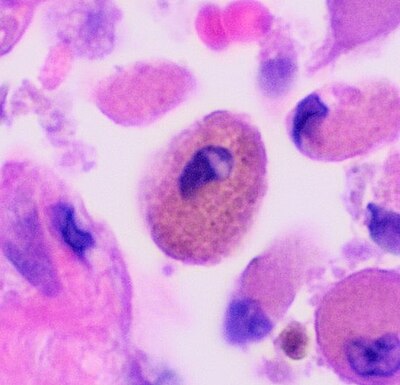


The Macrophage
Macrophages represent a vital class of white blood cells, serving as the primary phagocytic cells of the innate immune system. Their fundamental role involves the recognition, engulfment, and degradation of a wide array of targets, including microbial pathogens, apoptotic cells, cellular debris, and even cancerous cells that lack specific 'self' markers. This process of phagocytosis is a sophisticated mechanism that not only eliminates threats but also plays a crucial role in tissue homeostasis and repair.
Found ubiquitously throughout the body, macrophages patrol various microenvironments, adapting their morphology and function to suit their specific location. This remarkable plasticity allows them to exist in diverse forms, such as Kupffer cells in the liver, microglia in the central nervous system, alveolar macrophages in the lungs, and osteoclasts in bone, all contributing to the maintenance of local tissue health and defense. Their constant surveillance and rapid response are indispensable for preventing infection and injury from overwhelming the host.
The Antigen-Presenting Powerhouse
Beyond their role as frontline phagocytes, macrophages are critical intermediaries between the innate and adaptive immune systems. After internalizing and processing antigens from pathogens, they migrate to lymphoid organs or present these antigens on their surface via Major Histocompatibility Complex (MHC) class II molecules. This antigen presentation is a key step in activating T helper cells, which are central orchestrators of the adaptive immune response.
By initiating the adaptive immune cascade, macrophages help to tailor a highly specific and long-lasting defense against particular threats. Furthermore, macrophages secrete a variety of cytokines and chemokines that modulate the immune response, influencing the recruitment and activation of other immune cells, including lymphocytes, neutrophils, and dendritic cells. This intricate communication network highlights the macrophage's pivotal position in coordinating a comprehensive immune defense.
The Dual Nature
Macrophages exhibit a remarkable functional duality, capable of promoting inflammation to combat infection or suppressing inflammation to facilitate tissue repair. This polarization is often categorized into distinct phenotypes, such as the classically activated M1 macrophages and the alternatively activated M2 macrophages, although recent research suggests a more complex spectrum of activation states. M1 macrophages are typically induced by inflammatory stimuli like lipopolysaccharide (LPS) and interferon-gamma (IFN-γ).
They are potent killers, producing reactive oxygen species and nitric oxide (NO) from arginine, which are toxic to microbes. In contrast, M2 macrophages are often associated with tissue repair, wound healing, and immune regulation. They are induced by cytokines like IL-4 and IL-13 and metabolize arginine to ornithine, promoting collagen synthesis and tissue remodeling.
Understanding this polarization is crucial for developing therapeutic strategies targeting inflammatory diseases and promoting regenerative medicine.
Discovery and Modern Relevance
The journey of understanding macrophages began in 1884 when Élie Metchnikoff, a Russian zoologist, first observed and named these remarkable cells. His pioneering work on phagocytosis laid the foundation for modern immunology. Today, macrophages are central to our understanding of numerous physiological and pathological processes.
Dysfunctional macrophages are implicated in a wide range of severe diseases, including chronic granulomatous disease, autoimmune disorders, atherosclerosis, and cancer. Research into macrophage biology is a rapidly evolving field, with significant implications for developing novel therapies. Strategies aimed at modulating macrophage activity, such as repolarizing M2 macrophages towards an anti-tumor M1 phenotype or enhancing their phagocytic capacity, hold immense promise for treating cancer, infectious diseases, and chronic inflammatory conditions.
Their plasticity and central role make them a prime target for future medical interventions.
See also
Frequently Asked Questions
What is a macrophage?+
How do macrophages help fight infections?+
Where can macrophages be found in the body?+
Why do macrophages have different types like M1 and M2?+
When did scientists first learn about macrophages?+
Based on content from Wikipedia · Licensed under CC BY-SA 4.0