

Lysippos
Images

Alexander the Great, marble copy of the original by Lysippos, from Alexandria (Egypt), 3rd century BC, Ny Carlsberg Glyptotek, Copenhagen



The Artistic Crucible
Lysippos stands as a monumental figure in the annals of Greek sculpture, flourishing in the 4th century BC. His artistic output and influence were so profound that he is consistently ranked alongside Scopas and Praxiteles as one of the triumvirate of sculptors who defined the zenith of the Classical Greek era. More significantly, Lysippos is recognized as a crucial transitional figure, his innovations paving the way for the expressive and diverse aesthetics of the subsequent Hellenistic period.
His work marked a departure from the more rigid, idealized forms of earlier centuries, embracing a heightened sense of realism, psychological depth, and dynamic movement. This shift was not merely stylistic; it represented a fundamental change in how the human form and its potential for emotional expression were perceived and translated into three-dimensional art, setting new standards for artists across the Mediterranean world and beyond.
The Workshop Phenomenon and the Challenge of Attribution
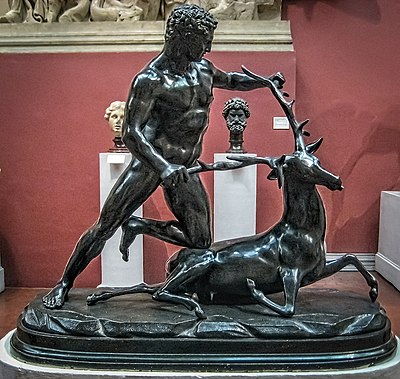
The sheer volume and widespread dissemination of Lysippos's work present a unique challenge for art historians. He commanded a large and highly skilled workshop, populated by numerous disciples who absorbed and replicated his signature style. Furthermore, the immense popularity of his sculptures led to a thriving market for replicas, produced both by his immediate circle and by independent artisans, extending well into the Hellenistic and Roman periods.
This proliferation of copies, often executed with considerable skill, makes the definitive attribution of specific works to Lysippos himself a complex and often debated scholarly endeavor. The difficulty lies in distinguishing the master's original touch from the skillful interpretations and reproductions by his contemporaries and followers, requiring meticulous analysis of stylistic nuances and historical context.
Innovations in Form and Proportion
Lysippos's genius lay in his radical departure from established sculptural conventions. He is credited with introducing new canons of proportion, often depicting figures with smaller heads and more slender, elongated bodies, which contributed to a sense of greater naturalism and grace. Crucially, he infused his sculptures with an unprecedented sense of movement and vitality.
Unlike the static poses common in earlier periods, Lysippos's figures often appear caught in a moment of action or contemplation, their musculature subtly rendered to suggest underlying tension and potential energy. This dynamic realism extended to his portrayal of emotions and individual character, moving beyond generic representations to capture the nuances of human experience. His approach fundamentally altered the viewer's relationship with sculpture, transforming static objects into engaging narratives.
The 'Victorious Youth' and the Enduring Echo of Lysippos
The rediscovery of the 'Victorious Youth,' also known as the Getty Bronze, around 1972, provided a significant tangible link to Lysippos's artistic legacy. This exceptionally preserved bronze statue, believed to be either a direct work by Lysippos or from his immediate workshop, exemplifies the qualities for which he is celebrated: anatomical precision, lifelike rendering, and a palpable sense of presence. Such finds are invaluable, offering concrete evidence that allows scholars to refine their understanding of his style and impact.
The 'Victorious Youth' serves as a powerful testament to the enduring appeal and technical mastery of Lysippos, whose innovations continued to resonate and inspire artists for centuries, shaping the trajectory of Western art.
Lysippos's Enduring Impact on Art History
The influence of Lysippos extends far beyond his own lifetime, fundamentally reshaping the course of Western art. By championing a more naturalistic and dynamically expressive approach to sculpture, he provided a crucial foundation for the subsequent Hellenistic period, which embraced a wider range of emotional and thematic content. His innovations in proportion and his ability to imbue his figures with a sense of psychological depth and movement set new benchmarks for artistic achievement.
The challenge of attributing works to him underscores his widespread impact, as his style became a benchmark that many artists sought to emulate. Lysippos did not merely create beautiful objects; he redefined the very possibilities of sculptural representation, leaving an indelible mark on how the human form and its inner life would be depicted for millennia to come.
See also
Frequently Asked Questions
Who was Lysippos?+
What made Lysippos's sculptures special?+
How did Lysippos change Greek sculpture?+
What is the 'Victorious Youth'?+
Why is it hard to know which sculptures are by Lysippos?+
Based on content from Wikipedia · Licensed under CC BY-SA 4.0